Products About Me Home Classroom Freebies TeachersPayTeachers Pinterest Email Facebook Image Map

August 23, 2014

Best find so far this school year: Magnetic tape!

We started our new school year last Monday, and even though I am already completely swamped with all of the exciting back-to-school activities, I am super thrilled about this year: I was fortunate enough to move into a bigger room! (No more having to move furniture around just to open the door all the way!)

I have been spending this past week moving my belongings and have started to decorate in order to create a cozy and inviting learning environment for my kiddos. I promise to post more updates on my amazing new Speech room when it is finished. But I had to take a moment to share an awesome discovery that is going to make my life a lot easier: Magnetic tape! Yes, it's like tape, but it's magnetic! Because I finally have access to a magnetic whiteboard, this find is a treasure! I have started to "magnetize" the visuals that I use on a consistent basis. Here is an example of how I have used the tape on my structure word visuals (I made these to go with the Visualizing & Verbalizing program by Lindamood-Bell):

Just stick the tape onto the back of your visual...                           ...and it will stick to any magnetic surface!
By the way, the tape on the whiteboard itself is vinyl electrical tape. I have used it to section off parts of the board. I will have more posts soon!
~Viola

August 4, 2014

Key Chain Rules

I briefly wanted to spread the word about a great tool for behavior / social skills management that I think may be underused: key chain rules!
I had heard about key chain rules from a number of sources over the last few years, but didn't actually make them myself until last school year. Key chain rules are little slips of paper, each of which contains a social rule or behavior strategy that a target student is working on. These cards are attached to a keychain (or book ring) so that the student can carry them around and quickly reference them.

Last year, a student with High Functioning Autism transferred to our school and he had tons of behaviors that we wrote oodles of social stories for. Those social stories all ended up in a binder, which made it somewhat difficult for him to quickly find and reference. This is what prompted me to try out key chain rules -- I began condensing the social stories into 2-3 sentences (we started with 5 - didn't want to overwhelm the poor guy!). He ended up really liking them. This tool was easy to make and can be quickly implemented. It might work best after the student has been exposed to the rules through a social story, but after repeated exposure, you can briefly remind them to "Remember Rule #4" if they forget. Just a quick idea before we return to school (can you believe this summer is almost over?)!
~Viola

July 7, 2014

Educational Insights Game Review #5: Pancake Pile-Up

Get it here!
The last one of my new Educational Insights games that I will be reviewing is "Pancake Pile-Up," a fun movement game that is also great for working on sequencing skills.

The object of this game is to replicate stacks of different-flavored pancakes shown on a card by putting the pancake on a spatula and racing it from the imaginary griddle to the plate. Whoever can do so the fastest without making a mistake is declared the winner (or the server who will earn the greatest tip).

What is great about this game is that it can be played with larger groups (2-12 players, ages 4 and up), making it a great choice for a social skills group or birthday party. Players are divided into two teams of servers. The pancakes on the griddle are placed next to the order cards approximately 15 feet away from the plates, or the customer's table. 

Go from this...                              ...to this!


The game starts by an order card being turned over - servers need to replicate the pattern by finding and stacking matching pancakes. They take turns racing the correct pancake from the griddle to the customer's table. The race concludes when a team manages to complete the pancake and places the butter patty on top. The other team will check to ensure no errors were made.

Serving pancakes!
I am aware that many of us SLPs lack the space to do an activity that spans over any distance because our speech rooms are often the size of broom closets -- you can easily modify this game by just doing it all in one spot. The way we did it was simply by placing the plate next to the griddle. When a student was done with their turn, the next student had to figure out which pancake would have to be next in the line-up. This worked really well and my 3rd grade SDC students still had fun! If you do have the space, this game is especially great for very active students who respond well to gross motor activities. Students really have to pay attention to what the other members on your team are doing and be vigilant in regards to which step they are on. This game lends a wonderful opportunity for working on sequencing skills as well!

The pancake fell off the stack.
We also practiced some basic social skills / problem-solving: if the pancake falls off the spatula, should you use your hands to pick it up and spread your germs on it? Or should you get a new pancake? What might happen if you touch someone else's food? Would you want to eat food that has fallen onto the ground or was touched by someone else's germy hands? Why not? etc.

This game can be used in a multitude of ways to promote language and other developmental skills. Here are some ideas:
  • Sequencing: You can work on sequential vocabulary with this game -- "First we put the blueberry pancake on the plate. Which pancake is next?"
  • Pretend Play: You can simply use the pancakes, plates, and spatula in play therapy! The pancakes and spatula are very durable and should hold up well.
  • Counting: You can have students count how many strawberries / blueberries / chocolate chips are on each pancake or how many pancakes are in your stack.
  • Social Skills / Teamwork: The relay race creates a wonderful opportunity for teamwork, as well as good sportsmanship.
  • Vocabulary: This game is great for working on vocabulary terms such as stack, spatula, griddle, plain, flavor, etc.
  • Basic Concepts: You can also work on basic concepts - "The banana pancake is between the plain pancake and the strawberry pancake."
  • Memory: Memory skills are exercised as students have to remember which step they are on.
  • Motor skills: Students will get a great exercise in balance and coordination in this game. It became especially challenging to balance the pancakes as stacks got taller!
I will definitely be using this game for my social skills group for team-building! This is another great speech room addition!
~Viola

July 3, 2014

Educational Insights Game Review #4: Laundry Jumble Game

Get it here.
Today I am reviewing one of my favorite Educational Insights products: "Laundry Jumble Game." The reason I like it so much is because it is extraordinarily versatile for use in Speech therapy. The game is recommended for ages 4 and up, although it could be used with younger populations if the rules are adapted (see some of my recommendations at the bottom of this post).

The game comes with a fabric dryer, game cards, and clothing items. The object of this game is to collect the most cards by matching correct clothing items to the picture on a card. On their turn, players pick a card and look at the clothing item. They then stick their hand into the dryer and feel around until they have found what they think is a matching item. If they get a match, they get to keep the card and return the clothing item to the dryer. If they do not get a match, they return the card and the clothing item. Players have to beware of the skunk's stinky polka-dotted underpants - if they accidentally pull them out, one of their game cards is returned to the draw pile.


My student is trying to find
the pink shirt
This game banks on students' tactile sense and their ability to feel for and identify small details with their sense of touch. This game is very similar in nature to "What's in Ned's Head," although smaller and easier to unpack / set up. It is also more difficult to peek into the dryer when compared to Ned's Head.

The quality of the game components is also excellent - the dryer seems very durable and the clothes are lovingly crafted with lots of details. The fabric dryer is very soft and pliable, keeping you unharmed if your student decides to whack you over the head with it. 
       The skunk...    ...and his stinky
                                  underpants!

I knew that my students would want to play this game as soon as I pointed out the picture of the skunk and its stinky underwear on the box - this was immediately followed by laughter and shouts of, "Can we play this?" Students had a lot of fun trying to feel for the correct clothing items, although many of them needed prompts and reminders to feel for small details, such as buttons, bows, sleeves, etc. Of course this game also provided a fantastic opportunity to work on playing honestly and not trying to cheat.

This game may be difficult for young players, but you can easily modify the difficulty level by removing some of the clothes from the dryer and playing only with a limited number of pieces (make sure you remove the corresponding cards from the deck, as well).


"Reverse" Laundry Jumble
I was also able to modify the game rules for our middle school students in the functional skills class (this population has very low cognitive abilities; most of the students are non-verbal): first, I spread out all of the clothes on the table for them to see. On their turn, students picked up a card and had to find the matching item to put it in the dryer. It was like playing the game in reverse and allowed this group of students to practice their matching skills.

Because this game is so easily modifiable, it is a valuable addition to any speech room, and you can use it to target a ton of skills! Please see the list below for some ideas I came up with:

  • Basic Concepts: Because the dryer has a clear front and back (and an inside!), you can use it to work on following directions. e.g., "Where are the skunk's underpants?" - "Next to the dryer").
  • Following Directions: This game would make a great tool for working on following directions. You could have students complete directives, such as, "Before putting the yellow shirt into the dryer, put in the green shorts."
  • Matching: This game is great for working on matching skills! You can play "reverse" Laundry Jumble as described above.
  • Describing: You can use the clothing to work on describing - you can have the students describe words such as colors, textures, shape, number of sleeves, etc.
  • Compare/Contrast: Similarly, you could ask students to compare and contrast two items of clothing.
  • Functional Living Skills: For lower cognitive functioning students (or even adult TBI or stroke patients), you could work on daily living skills, such as sorting laundry - have clients separate all the light-colored clothing from the dark-colored clothing.
  • Sensory diet: This game could be worked into a student's sensory diet - there are several different textures to explore.
  • Impulsivity: Students will have to learn to carefully feel for details and not just pull out the first item they touch.
  • Vocabulary: This game can be used to introduce a lot of great new vocabulary besides colors: e.g., sleeve, brim, seam, collar, buttons, strap, bow, etc.
  • Grammar: This game lends itself well to grammar targets such as possessive pronouns ("Whose underpants are they?"-"They are his underpants."), subjective pronouns, and 3rd person singular conjugation ("He has green shorts."). Many of my students struggle with this!
  • Fine Motor Skills: Students will have to be careful not to grab, but use a pincer grasp - otherwise, all of the clothes will come flying out of the dryer!
  • Pretend Play: And, of course, the game would make a great tool for pretend play in play therapy, since the clothes are very realistic!
  • Guessing game: Because the dryer nicely obscures anything inside, you can play a guessing game by placing a random item inside, having students touch it, and guess what it is.
  • Social Skills: We used this game to work on fair play and not attempting to peek into the dryer!
If you only have money to purchase one of the Educational Insights games that I am reviewing here, I would recommend you get this one, since you will get the biggest bang out of your buck with this choice!
~Viola

June 30, 2014

Educational Insights Game Review #3: The Sneaky, Snacky Squirrel Card Game!

Get it here.
I have another Educational Insights game review for you! If you like "The Sneaky, Snacky Squirrel Game!", you might enjoy the card game version, as well! This stand-alone game is an especially neat tool for SLPs, school psychologists, or behavior therapists to target impulse control, attention, and social skills. The recommended age range is 4 years and up and this game supports 3-6 players (or two students and an adult facilitator).


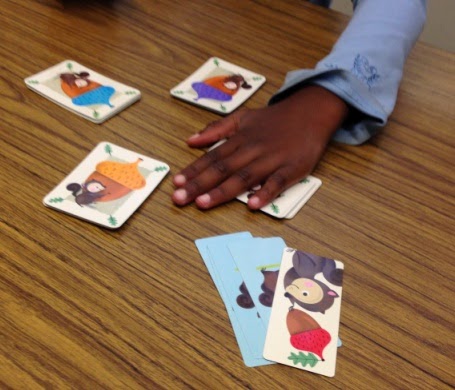
Slap the matching acorn card.
As with the original "The Sneaky, Snacky Squirrel Game!", the object of this game is to collect as many acorns as possible. This version consists of two separate card decks: rectangular acorn cards that come in four different colors and elongated squirrel cards. The acorn cards are placed in the middle of the table so that all players can easily reach them. Next, one person who is the "dealer" (or the SLP) pulls out one of the elongated squirrel cards. For each card that has a squirrel on a blue background, the dealer says, "Sneaky" -- nothing happens for these cards. However, if the card depicts a squirrel and an acorn, the dealer says, "Snacky!" and players have to slap the matching colored acorn card. Whoever slaps the card first, receives the acorn card. Sometimes, a snacky card features two acorns, in which case two players have a chance to earn a card.

This game emphasizes a student's vigilance and reaction speed. Players have to pay close attention to what cards are being drawn and be the quickest to touch the matching color. I had several students attempt to "hover" their hands over the acorn cards, which offered a great opportunity to talk about why this might be considered cheating. In order to increase students' impulse control during this game, I implemented the rule that if they slapped the wrong card, or slapped when a "Sneaky" card was being dealt, they would have to return an acorn card from their pile.

This game is great for Speech because the turns are very quick -- which is important when playing a game during articulation drills or when in large therapy groups. You could even have students complete different tasks for differently colored acorns. For example, for each yellow acorn, students practice their target word 5 times, for each red acorn they practice 10 times, etc. This would also be a great game for students working on /s/-blends ("sneaky," "snacky," "squirrel").

Stay posted! In the next few days I will be reviewing my very favorite game of all the samples I received!
~Viola

Educational Insights Game Review #2: The Sneaky, Snacky Squirrel Game!

Get it here.
The Sneaky, Snacky Squirrel Game! is another great game by Educational Insights that I have the pleasure of reviewing! If you are an SLP, the odds are that you own Hi-Ho Cherry-O. And, odds are, you're pretty tired of it (I know I am). This is were this game offers a great replacement since the game play follows the same principle of play as Hi-Ho-Cherry-O, but it adds some additional educational components, which makes it more viable for the therapy room.

Game components.
The object of the game is simple: collect different-colored acorns from the tree to fill up your tree stump. Once you have collected all five colors, you win. A spinner dictates which color acorn you get to collect. But watch out -- if you get the storm cloud all your acorns get blown back onto the tree. And if you get the sad squirrel, you lose a turn. Also beware of the thieving squirrel that allows other players to steal one of your acorns from your tree stump. If you  get lucky, your spinner will land on a color, a "1", or a "2", which are the fields needed to pick acorns. The recommended age range is 3 years and up, but I played this with language-delayed third-graders and they still liked it.

This student needed a prompt to pinch
the squirrel lower in order to
move his paws.
Not only does this game work on counting and color-matching skills, but there are other educational aspects. The thing that really differentiates this game from Hi-Ho Cherry-O is the fine motor component: on their turn, players use the plastic squirrel tongs to pick up the acorns. This really allows them to work on their hand strength and fine motor control while playing! Also, I find that the pieces in this game don't get lost as easily as the cherries in Hi-Ho Cherry-O as they are a little bigger and can be easily counted during clean-up (there should be four of each color) to make sure they're all still there. The game components are also higher quality and the acorns have a rubber-y texture to them.

This would make a great game for preschool SLPs as well as Occupational Therapists. I know I will be showing it to the OT at my site! I also know that now that I have this game, I will donate my old Hi-Ho Cherry-O to Goodwill since I'd rather play this.

If you prefer dogs to squirrels, check out a similar dog version of this game by clicking here.
~Viola

June 26, 2014

Educational Insights Game Review #1: Kitten Caboodle & Diggity Dogs

I was really fortunate in that I received a very generous game donation from Educational Insights, and wanted to review my new speech room additions for all of you fellow SLPs. I already owned several of the company's products, all of which are a hit with my students, so I knew to expect high quality games with solid educational value. My summer school students are the lucky cohort to sample these games first. Over the next couple of weeks, I will be posting about how to use these games in speech therapy, so make sure to check back often!

Available here and here.
The first two games we tried out were Kitten Caboodle and Diggity Dogs. Both are essentially based on the same concept, but one version features cats, and the other version features dogs. If you know me, you know that I love kitties, so I was super excited about the cat version of this game >^..^< !

Game items.
Each game comes with a deck of cards and a collection of seven cardboard cats or dogs, each of which have a thinking bubble. The thinking bubbles contain three items that the animal desires: a toy, food, a pet bed, etc. The cards contain pictures of the items. The object of this game is simple: Collect the set of desired items in order to adopt a particular cat or a dog. The game ends when all of the animals have found a home. Whoever ends up with the most animals, is the winner.

The play style is similar to Go Fish: each player starts out with two picture cards from the draw pile, and takes turns asking other players for items they need. If the player does not get a match, s/he picks up a card from the draw pile. Once the three items are collected, a player gets to exchange the items for their animal.

My 4th grade SDC students enjoyed the dog version of this game!
It sounds simple enough, but unlike Go Fish, this game consists of much more planning and adds an aspect of competition to it when two players want to adopt the same animal (for some reason everyone was hell-bent on getting Austin, the cat). I love the logical thinking and memory components, as well: students need to figure out which items they already have and which animal would be the easiest to obtain given the cards they already own. They also need to remember who asked for certain items in previous turns.

Some additional fun aspects described in the instruction booklet are as follows: 1. Have students ask in their best dog/cat voice, 2. customize the game by taping pictures of your own cat or dog onto the cardboard cut-outs. The instructions also feature a profile of each of the animals.

Use both sets at once for an additional challenge!

Another really cool modification I came up with to make the game more challenging for older students: mix both sets together! This will require students to engage in additional planning. And you won't have to choose between which game you want to play -- they both feature really endearing animals and you will want to adopt them all :).

But now let's get to how these games can help us in the Speech therapy setting. Here are some of the ways I was able to use the games with my students this week:
  • Perspective Taking: This game is awesome because it features THOUGHT BUBBLES! Yay! You can use the different animal cut outs to talk about that each animal has different desires and thoughts (much like people) and chat about the difference between thought bubbles and talking bubbles.
  • Inferencing: You can do some basic inferencing practice - what do you think the dog wants the stick for? What do you think might be inside this can?
  • Asking Questions: A lot of my students struggle with the grammatical structure of questions beginning with auxiliaries (do/can/is), so this offered a great way to practice this skill, since they had to ask players, "Do you have a..."
  • Logical Thinking / Problem Solving: Students have to think about the items they already have in their hand and which animals they could adopt with these items. They also need to think about which animals would be the easiest to adopt. For example, if they have a mouse and a ball of yarn, they would look to see if there is a cat who might like both of those items, and then plan what other item they should ask for.
  • Social Skills: As with most games, this game involves turn-taking and good sportsmanship (no cheating, peeking, lying -- I've already had kids trying to do all of these things with this game!).
I definitely recommend these two games! Of course you could also use them to make articulation drills more fun! And what are my own cats Boone and Orson thinking about? I wonder...

My cats have a one-track mind!
~Viola