Products About Me Home Classroom Freebies TeachersPayTeachers Pinterest Email Facebook Image Map
Showing posts with label ASD. Show all posts

September 21, 2014

Social Skills Curriculum / How I Spent My Summer

When I began working in the public schools, I quickly realized that there was a great need for social skills groups. Parents and staff seemed to be under the impression that this was an area of expertise for SLPs -- which most of you would agree is definitely NOT an accurate assumption! The only instruction on social skills that I have received in my graduate program is to be taught the definition of the term "pragmatics." That's pretty much where it ended. However, I was expected to work on this with a large number of students.

Not sure where to begin, I purchased tons of books on the subject. Unfortunately, most programs out there didn’t meet my needs – the lessons and activities were either too challenging / not engaging / too easy / required materials that you had to make yourself / etc. And - don't hate me - but even Michelle Garcia Winner's materials were a bit too dry for my students.

Over the last three years I have taught elementary level social skills groups by piece-mealing my own curriculum and developing my own lessons and activities. This summer, I decided to relinquish my break and finally sat down to type up actual lesson plans, including some of the activities that I have done with my groups and adding many, many more ready-to-use materials and activities. While this project pretty much consumed my summer break, I felt it was something that I really had to do. The finished result is a resource that is (hopefully!) easy to implement and can be used with different elementary populations to work on social skills.

https://www.teacherspayteachers.com/Product/Elementary-Social-Skills-Group-Curriculum-40-Lesson-Plans-250-Act-HFA-ASD-2837426
Click on the picture to see the product in my TPT store!
The completed bundle contains 37 lesson plans and 229 supplementary activities for Elementary to Middle school level social skills groups. Each lesson is designed to last between 30 – 60 minutes (although you can stretch each lesson across several sessions by doing multiple of the included activities). Of course it is ready for sale in my TPT store (I have also made the individual sections available).
 Each lesson contains a variety of activities to choose from so that you can pick the one that most suits the group you are teaching and/or your teaching style. While some of these activities focus on relevant children’s books and require that you own the book, most of the activities are original creations by myself.
Each lesson is set up as follows: Students are being taught the skill during a whole group discussion. The second part of each lesson is comprised of activities. Each lesson contains 3-13 suggestions for relevant activities, and this section will hopefully grow over time as I discover more things to do with my groups. The topics covered in my curriculum are as follows (each individual section is also available for sale if you do not want to purchase the entire program):
http://www.teacherspayteachers.com/Product/Social-Skills-Group-Curriculum-37-Lessons-229-Activities-HFA-ASD-Elementary-1366420
Some sample activity pages.
I.FRIENDSHIP BASICS
Lesson #01: Introduction to Social Skills Group (+3 Activities)
Lesson #02: Behavior Expectations and Rules (+6 Activities)
Lesson #03: Introducing Yourself (+3 Activities)
Lesson #04: Getting to Know Each Other (+6 Activities)
Lesson #05: What Is a Friend? (+4 Activities)
Lesson #06: Filling Buckets (+3 Activities)
Lesson #07: Giving and Receiving Compliments (+3 Activities
II.CONVERSATION SKILLS
Lesson #08: Whole Body Listening (+6 Activities)
Lesson #09: STEPS (an acronym developed by myself) (+3 Activities)
Lesson #10: S = Space (+5 Activities)
Lesson #11: T = Take Turns (+6 Activities)
Lesson #12: E = Eye Contact (+6 Activities)
Lesson #13: P = Polite (+3 Activities)
Lesson #14: S = Stay on Topic (+6 Activities)
Lesson #15: Volume (+5 Activities)
III.FEELINGS & ANGER MANAGEMENT
Lesson #16: Basic Emotions  (+8 Activities)
Lesson #17: Complex Emotions (+9 Activities)
Lesson #18: Body Language & Prosody (+5 Activities)
Lesson #19: Dealing With Anger (+10 Activities)
Lesson #20: Relaxation Techniques (+8 Activities)
Lesson #21: Sensory Techniques (+13 Activities)
Lesson #22: Dealing With Change (+7 Activities)
Lesson #23: Self-Control (+5 Activities)
IV. BEING PART OF A GROUP
Lesson #24: Joining a Group (+5 Activities)
Lesson #25: Playing a Game  (+7 Activities)
Lesson #26: Dealing With Losing (+6 Activities)
Lesson #27: Sharing (+8 Activities)
Lesson #28: Fairness & Compromising (+9 Activities)
V. PROBLEM-SOLVING & MANAGING CONFLICTS
Lesson #29: Identifying Problem Sizes   (+4 Activities)
Lesson #30: Solving Problems (+8 Activities)
Lesson #31: Group Problem-Solving (+5 Activities)
Lesson #32: Bullying (+9 Activities)
Lesson #33: Dealing With Teasing (+7 Activities)
Lesson #34: Tattling (+4 Activities)
Lesson #35: Resolving Conflicts (+9 Activities)
VI. SOCIAL THINKING
Lesson #36: Perspective-Taking (+10 Activities)
Lesson #37: Thinking & Talking Bubbles (+5 Activities)
I am planning to add more lessons on SOCIAL THINKING within the next months and have drafted outlines for the following topics:
Lesson #38: Social Filter
Lesson #39: Flexible Thinking
Lesson #40: Empathy
These lessons offer a great pre-cursor to higher-level social skills programs and are designed to be a comprehensive first exposure to a social skills group. While I organized these lessons by category, you can of course use them in any order you see fit, and they can be stand-alone lessons. You can do these lessons in a social skills group setting, in a whole classroom setting, or during a speech therapy / counseling session as needed.
I have started using this curriculum with my groups last week and will post a lot of updates this year about how it is working out for us! I think this is the first year where I don't have to go into the social skills group with just a vague idea of what we're doing that day, and that feels great!
~Viola

August 4, 2014

Key Chain Rules

I briefly wanted to spread the word about a great tool for behavior / social skills management that I think may be underused: key chain rules!
I had heard about key chain rules from a number of sources over the last few years, but didn't actually make them myself until last school year. Key chain rules are little slips of paper, each of which contains a social rule or behavior strategy that a target student is working on. These cards are attached to a keychain (or book ring) so that the student can carry them around and quickly reference them.

Last year, a student with High Functioning Autism transferred to our school and he had tons of behaviors that we wrote oodles of social stories for. Those social stories all ended up in a binder, which made it somewhat difficult for him to quickly find and reference. This is what prompted me to try out key chain rules -- I began condensing the social stories into 2-3 sentences (we started with 5 - didn't want to overwhelm the poor guy!). He ended up really liking them. This tool was easy to make and can be quickly implemented. It might work best after the student has been exposed to the rules through a social story, but after repeated exposure, you can briefly remind them to "Remember Rule #4" if they forget. Just a quick idea before we return to school (can you believe this summer is almost over?)!
~Viola

June 18, 2014

Book Review: "Interrupting Chicken" by David Ezra Stein & activity

"Interrupting Chicken" cover - available here.
One of my favorite events during the school year is our book fair -- I always find some good books to use in therapy. This year I got really lucky again - I discovered the book "Interrupting Chicken" by David Ezra Stein. I was immediately drawn in by the title and cover image, since it features talk bubbles. I had just introduced thinking and talking bubbles with my social skills group and we had also been working on not blurting out and interrupting. This book is relevant for both of these skill areas, and may be for you!

Sample pages.
The story deals with a young chicken who begs his father for a bed time story. Papa Chicken warns him not to interrupt the story, and the little red chicken promises. Of course it doesn't take long for the little red chicken to break his promise, and he blurts out a possible ending for the story. The author lovingly illustrated this  by adding in talking bubbles that look a little bit chaotic. Papa Chicken attempts to read three stories, but gets interrupted each time, at which point he has had enough and tells the little red chicken to create his own story. Little red chicken does so, only to get interrupted by Papa Chicken's snoring. My students (1st through 4th grade)  thought this story was hilarious and got a few good laughs in every time the little red chicken interrupted the story with his goofy antics. We discussed how little chicken's interrupting affected the story and how it made Papa Chicken feel. We also talked about how to interrupt appropriately (something we had been working on throughout the year). 

Interrupting activity set-up.
Next, I introduced a game to work on not interrupting others' turn to talk. I gave each student three glass gems (these can be found in the home decor aisle at Walmart or Michael's) and placed a container with the rest of the gems in the middle of our circle. Students took turns talking about a topic of their choice (e.g., what they had done on the weekend, their favorite movie or video game, etc.). Other students had to sit and listen. If they interrupted the student whose turn it was to talk, they had to place one of their gems back into the container. They were able to "earn" gems by using appropriate interrupting strategies. At the end we compared who had the most gems. Since our students tend to be really competitive in nature, they really enjoyed this lesson. Once you have introduced this activity, you can continue using it for future social skills sessions to keep practicing this skill.
~Viola

February 17, 2014

Social Skills Take-home Worksheets

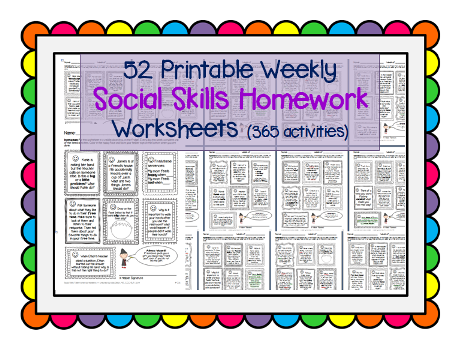
I don't want to brag, but I dare say that I may have completed my magnum opus: a packet of weekly social skills worksheets to last me throughout the year. This was a long-term project that I had been planning and working on for a while, since there was quite a need among my caseload. 

I created 365 social skills prompts /scenarios and distributed them across a 52-page document so that they can be sent home on a weekly basis. The activities are designed to target a variety of skills, including:
-Social problem solving
-Conversation skills / pragmatics (Topic maintenance, Turn-taking, Eye Contact, Proxemics, etc.)
-Critical thinking skills
-Cooperative play skills
-Figurative language
-Feelings / emotions
-Anger management
-Manners / Etiquette
-Social Inferencing
-Perspective taking
-Positive character traits
-Cause & effect / Predicting outcomes
-Flexible thinking
-Conflict resolution

This makes these worksheets the perfect Speech homework for students on the Autism Spectrum (HFA), those with Social skill or problem-solving deficits, those working on pragmatics, or even just our language kiddos. In addition to the activities, I included an “Advice Wizard” on each page, that offers a little tidbit of social advice. I also included a blank page so that specific scenarios can be added as needed. A sample page looks like this:
Sample social skills homework page
I did make this product available in my TpT store here. It is a little bit more expensive than the rest of my materials due to the extensive amount of time I put into it.
http://www.teacherspayteachers.com/Product/Social-Skills-Weekly-Homework-Worksheets-365-activities-Speech-ASD-Pragmatic-1120085

I really hope that my own students will benefit from this program -- it is so difficult to find relevant worksheets for social skills and I always have parents asking me what they can do at home to practice social skills. And I know my students will be so excited to get Speech homework!

Okay, I'm off to take some Motrin! This project really did a number on my head!
~Viola

February 10, 2014

Valentine Social Skills

The Valentine festivities continue with my home-made activities! Because I have so many students working on social and conversation skills, I made a Valentine-themed activity targeting those areas (I had previously created similar activities for Thanksgiving and Christmas, and they were well-received by my students).

The purpose of this game is to get as many matching chocolates into a candy box by answering questions about social skills scenarios. Below is an example of some of the prompts:
Sample prompts.
Once they answer a question, students have to find the matching candy and place it onto the picture of a heart-shaped box. I am thinking that it might be fun to get a real candy box and have them place the candy in there! Maybe I will snag one up for next year when the Valentine sales begin on 02/15 :).

My student is placing a matching candy into the box.
I think my students' favorite aspect of this game was to find the matching chocolates, since they looked all so similar. I suppose this was great practice for their visual skills, as well! This activity is available in my TpT store here. It comes complete with 36 prompts and 9 blank cards to add your own to the mix.

~Viola

February 6, 2014

TpT Freebie: Valentine's Day Sequencing Cards

My downloadable freebie this month are Valentine's Day sequencing cards that I created in Boardmaker. 
I made these with some of my special day class students in mind. These would work well to review the routine of Valentine's Day, to use in a social story, or simply to work on sequencing. They are available here
 ~Viola

November 21, 2013

Using visual cues to work on play-based turn-taking

Phew, between progress reports, parent-teacher conferences, and frantic attempts to cram as many groups as possible into our shortened minimum days, I completely managed to neglect this blog over the last few days. Now that Thanksgiving break is around the corner, things are finally calming down a bit. Time for an update!

I thought I would write about a specific approach that I used with one of my lower functioning ASD students to teach play-based turn-taking skills. With the rise in children diagnosed with Autism Spectrum Disorders we all have students working on social goals. This is an area that most of us do not feel super comfortable with since there seems to be a distinct lack of instruction on this topic in graduate school. In addition, often parents want to see playground/recess-based goals, which aren't always appropriate. I think parents don't understand that this type of outdoor play is extremely unstructured and overwhelming -- it is my belief that these kids need to master the skill in a highly structured environment first before we can take it outside. Also, I don't make it out on the playground as often as I want to, which makes it difficult to work on these goals with the necessary rigor.

Anyway, my student is a 3rd grade student attending our special day class. He has been diagnosed with ASD at an early age. Although he is verbal, his utterances are limited to delayed echolalia, refusal, and requesting desired items. His MLU is about 3-4. There is not much intrinsic motivation to engage in social activities or initiate conversations or other verbal exchanges. Of course, as with most parents of our ASD students, there was a push to include social goals in addition to language targets. During our sessions I noticed that although the student is able to adhere to rules of a simple game, he needed constant verbal prompting for each step in order to recognize when it was his turn, initiate, and then follow through with his turn. Because we often play games while working on our speech goals, I figured that this was something I could easily work on in the speech setting while practicing the rest of our targets. The goal I ended up drafting was as follows:

By (date), given an age-appropriate turn taking activity (i.e. a board game) with a peer or staff member, (student) will initiate his turn and follow through with it, with visual prompts only, 4/5 trials, in a structured setting, as measured by SLP observation and tally.
 
I selected three high interest target games and created three sets of visual prompts:

1. A choice board depicting the game selection and a sentence frame:

2. On the back of this card, I placed a visual reminder of "My turn":

3. I then continued to create visual rules for each of the three games:

It only took a few sessions for the student to learn to request a game appropriately and master the rules. If he did not initiate a turn, I briefly flashed or tapped the "My Turn" cue which sufficed to get him started. If he did not follow through with a turn, I tapped the specific rule. This approach really helped my little guy and by the end of the year he had gotten a lot better with turn-initiation (although we weren't able to completely fade out the "My Turn" visual). I think it is important though to see the growth and improvement with these students, even if it comes in small steps and minute increments...
~Viola

November 10, 2013

TpT Freebie: Idiomatic Expressions Checklist

With the rise of Autism Spectrum Disorders I have more and more students each year who struggle with figurative language. My TpT Freebie for November is a checklist containing a large variety of common idiomatic expressions that our students may come across in different settings. I made this to help me assess which idioms my students are already familiar with and which ones they still need to master. Of course this list is not comprehensive, but it is a start. You can make checks in different colors (e.g., green for mastered, red for expressions that are not mastered) to help you visually organize your targets.
Idiomatic Expressions Checklist - get it here
I have also sent this list home with parents and asked for their input as to which expressions they would like me to work on. I hope you find this helpful!
~Viola