Products About Me Home Classroom Freebies TeachersPayTeachers Pinterest Email Facebook Image Map
Showing posts with label TpT. Show all posts

September 26, 2018

Simplify Articuation Therapy with Word Cards


After 10 years of using them, I have to admit I am so over individual articulation card decks. While they are great when playing Go Fish or some other type of matching game, they are a real pain in the you know what for drill-type activities. They rarely stay in the order I want them in and all get mixed up, sometimes ending up spread all over the table.

This is why Word Cards are one of my favorite things to use. Word cards are basically just a single sheet with a bunch of words printed on it. Each card is organized and color-coded by word position. You can whip out a sheet in therapy and just have students "go" without worrying about flipping cards and potentially creating a mess on the table. Since many of my younger students are not proficient readers yet, I wanted not just a word list, but needed something with picture supports.I had made my first Word card many years ago using the clip art available in Microsoft Word. I finally got around to remaking the cards and "beautifying" them by using cuter clip art. So now you too can indulge! They have been a a true life saver and are available on TPT here.

I use these cards for drills, bingo (you can do this when students are working on different cards), and other open-ended activities (finding a word by listening to the description, comparing and contrasting two words, etc.).

These cards are also great for a functional bulletin board idea that also serves as a storage opportunity. For each sound, I cut the top 3" off a large manila envelope, wrote the sound on it (I used thinking/talking bubble bulletin accents from Lakeshore), and laminated it. Then I used thumbtacks to stick each envelope on the wall and placed my cards inside. When students get to Speech, I can just tell them which card to grab. For example, if they are working on /r/ in medial position, I will say, "Grab a blue /r/ card". That way they can get started on their drills with no time wasted.

If you pick up these cards in my store, I hope you love them as much as I do!! Leave a comment to share how you would use these cards!

September 26, 2017

Using STEM in Speech: Density

One of my professional goals this year is to incorporate more STEM (Science-Technology-Engineering-Math) Activities in my therapy setting. STEM concepts and activities are rich in language and the hands-on nature of many of the activities lends itself wonderfully to our population. I am planning to have a monthly theme to support  this objective, so this blog series is a summary of my progress.

Our September theme was Density (Sink/Float). Not only is this super easy to implement in the therapy room, but you can target tons of language and articulation concepts with this lesson. Most of my groups got to do this and they seemed to have a blast (many kids asked if we could do this activity again during their next Speech session).

Before we started we had a brief discussion of molecules and density (i.e. how much something weights compared to how much space it takes up). We also defined the terms "sinking" versus "floating". Visuals are super helpful for this. 

All you need for the hands-on/experimentation portion of this lesson is a tub of water (perhaps with food coloring in it for effect) and various items collected from around your house or classroom. Make sure the items are small enough to fit into the tub. Some easy finds are: pencils, coins, dice, pompoms, leaves, twigs, rocks, keys, paperclips, erasers, markers, etc. 

Allow students to make a prediction (make sure to define this term!) about what they think will happen to the item before actually placing it in the water to watch the result.

I created a number of worksheets of varying difficulty levels that would allow students to record their predictions as well as the resulting observations. A lot of my younger students had a hard time navigating where to record each observation (they would often try to color in the wrong row), so this provided an excellent teaching opportunity.


Worksheet for my younger kiddos with pre-entered items.
Worksheet for my older kiddos - a little more complex.
 

We placed visuals on the board (with Magnet Tape) to keep track of whether the "Sinkers" or "Floaters" would win. You can also use the visual cards to let students randomly select one to see which item would be the next "experiment". My students had a lot of fun with this. I also "challenged" them to solve certain Sink/Float predicaments (e.g., how do you make a rock float using only a balloon) to stimulate problem solving and critical thinking skills. 

Additionally, I used this activity in my social skills group to work on turn-taking, interrupting, problem-solving, and dealing with making the wrong predictions. 

You can also adapt this lesson and turn it into a push-in classroom unit. I pushed into our younger SDC class and as a group we made predictions about the various items. To make the concepts more visually concrete, I drew a tub of water on the whiteboard and had students place the items onto the drawing based on whether they thought the items would sink or float.


With my articulation groups, we tested items that contained the target sound of students - you can see in the picture of one of the worksheets above that all of the items contain the /r/ sound. And the words "sink" and "float" are great for /s/, /k/, and /l/ kiddos!! I absolutely loved the versatility of this lesson!

If you want to try this with your own students and like the visuals/worksheets that I have used - they are available on TPT here. The unit also includes challenges and material lists with items containing specific phonemes.

This was a pretty successful lesson - I can't wait for our next monthly STEM unit!

October 18, 2016

Trademarks: A Valuable Lesson Learned

Today I was reminded how important it is to pay attention to Trademark and Copyright information. A couple of my products were removed from TPT, as they used the term "Social Thinking", which is apparently trademarked. This phrase gets thrown around so much in our field, I had no idea that this was someone's intellectual property! Unfortunately one of these removed products was my Social Skills Curriculum :(. If you have previously purchased it - don't worry! You can still access the file under your purchased items.

But - when life hands you lemons you make lemonade: I made all of the necessary changes to my curriculum, removing any reference to "Social Thinking". Instead, I used my own coined phrase: "Socio-Cognitive Skills" (and now I am thinking about trademarking THAT, haha!). I also took this opportunity to redo the product cover, which has long bothered me. The new cover is a lot less busy:


So --- problem solved and valuable lesson learned! I have reposted the curriculum HERE. I am also working with TPT to see if I can get the old version reinstated with the changed wording. I would hate to lose all of my feedback!

To avoid this happening to you, make sure to reference potential trademarks on the United States Patent and Trademark Office website.

February 23, 2015

TPT Freebie & Sale Announcement

To celebrate the fact that I recently reached 500 followers on TPT, I posted this freebie: Articulation UNO - /s/ and /z/ edition! Just click on the picture to download.
https://www.teacherspayteachers.com/Product/FREEBIE-UNO-Articulation-game-for-s-z-sounds-Speech-therapy-1721794
Articulation UNO
To sweeten the deal, TPT had immaculate timing and announced a sitewide sale coming 02/25 & 02/26! That means you can get up to 28% off TPT items that are participating in the sale if you enter the promo code HEROES at checkout. I love taking advantage of these opportunities to stock up on products, since their sitewide sales only occur a few times a year. Happy shopping!
(Banner courtesy of Meredith Anderson)

January 22, 2015

Teaching Students How to Size Up a Problem

https://www.teacherspayteachers.com/Product/Problem-Solving-Pack-Unit-on-little-medium-big-problems-social-skills-ASD-1279690
Get it here!
I haven't advertised a TPT item in a while, so I thought I would showcase one of the

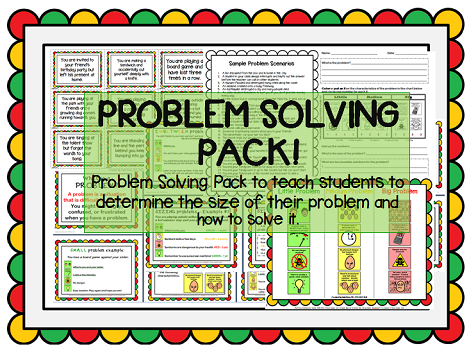
more popular items in my store: a "Problem Solving Pack" created to show students how to accurately define the size of a problem and to teach basic critical thinking and beginning problem-solving skills. 

I have a lot of kiddos on my caseload that have a complete meltdown when they lose a game or during some other trivial mishap, which is what inspired me to create this resource. Since this is usually an area of need for students on the ASD spectrum or those with social communication disorder, most SLPs can probably find value in this packet.

Problem sizes are grouped by little, medium, and big, and in order to fit a particular size, students are encouraged to think of the four aspects that make up a problem:

(1) the number of people involved in or affected by the problem
(2) the duration of the problem
(3) the level of physical danger involved
(4) the time it takes to solve this problem

I assigned numerical values to each characteristic, which helps students "calculate" the actual problem size in a very structured manner. Students can then fill out an accompanying worksheet to help them organize and guide their thought process.
Overall, this packet includes the following PDF files:
• A collection of 120 premade problem scenarios in two separate formats (as 3.6” X 2.6” cards as well as in black and white list format)
• 9 blank cards to add your own scenarios as they occur in your students’ lives

• A step by step lesson plan / presentation to go over with your students
• A letter-sized visual poster to remind students of the characteristics of each problem size (both color and black and white)
• A worksheet template to help guide students through analyzing a problem's size
• 4 sample worksheets to guide the teacher / therapist on how the questions should be answered

I created and improved upon this packet throughout the last school year as I was developing and using these lessons with my own students in a social skills group and small group therapy setting. It really seemed to work for many of them – I, as well as other support staff have noted some marked improvements in target students’ reasoning and behavior control skills about daily challenges.

I have used these materials with 1st through 5th graders (although the worksheet is geared towards my older groups), but will work well for middle school and high school students as well due to the relative complexity of the subject. You can also just use the problem solving cards as a quick therapy activity to work on identifying and solving problems. 


For some other great resources on problem-solving using the four problem characteristics, visit Jill Kuzma's blog. There are also some great resources on Pinterest. Problem-solving is such a basic skill that we take for granted. It is important to remember that many of our students need guided teaching to improve and master this concept.
~Viola

November 30, 2014

TPT Cyber Monday Sale December 1st-2nd

Don't miss out on this year's TPT sitewide Cyber Monday Sale! The sale will go from December 1st - December 2nd and you will get additional savings if you enter the promo code TPTCYBER at checkout. 

Of course I am participating, as well, along with thousands of other sellers! Please come visit my store, you never know when the next big sale date will be.
~Viola

October 29, 2014

Halloween Sale

I just wanted to make a quick announcement: all of my Halloween-themed products on TPT will be 15% off October 30th and October 31st! Click on the picture to be redirected to my store!
http://www.teacherspayteachers.com/Store/Miss-Vs-Speech-World

October 26, 2014

Halloween Social Skills Activity

Available on TPT.
One of the things that I am always in need of are new materials to target social skills and problem-solving. I figured that Halloween brings with it some unique or unusual situations in which students may need to problem-solve, so I created a bunch of scenarios.

To make this activity more motivating, I presented them in a game format: Each student receives a candy bucket that they will have to fill. Each scenario depicts a piece of candy of a different color. On their turn, the student picks a card and tries to solve the problem on the card. The cards include scenarios such as:
  • 
    Example of game play.
    Amanda is going trick or treating. In front of one of the houses, there is a filled candy bowl with a sign that says, “Take one.” Amanda takes almost all of the candy and puts it into her bag. What did Amanda do wrong? Why were her actions wrong?
  • Eric is going trick or treating. In front of one of the houses there is a large dog tied up right next to the door and it is growling at him. Should Eric go up to the house? Why or why not?
  • Hailey is participating in a costume parade at her school. A classmate accidentally steps on her costume and it rips. How could this problem have been prevented? What could Hailey do?
  • Jane is going trick or treating. A man opens the door and says, “I have a bunch of candy. But you have to come inside the house so I can give you some!” What should Jane do? Why?
 If this game sounds like a fit for students on your caseload, you can find it in my TPT store.
~Viola

October 11, 2014

Halloween Inferencing Activity

With Halloween drawing close, I figured I should share some of the themed activities that I created for my students this year. I do have quite a few groups working on logical thinking, listening, and inferencing skills, so I love doing "riddle" type activities with them. My Easter Egg Inferences were a pretty big hit with my students, so I figured I should create a similar activity with a Halloween theme.

http://www.teacherspayteachers.com/Product/Halloween-themed-Inferencing-Activity-Guess-the-mystery-item-Speech-therapy-1388927
Halloween Inferencing - get it here!

The activity consists of 54 gravestone cards, each of which features three clues. Students then have to guess what lies buried in this spot. To check their answers, they flip over the card to reveal a picture on the back. Several of the cards feature Halloween-themed objects, alongside common every-day items. Blank cards are included so you can add your own! If you teach large groups, it might be fun (or macabre!) to have student pictures on the back and write clues about them onto the gravestone. The riddles are fairly easy and would probably be most appropriate for Pre-2nd grade, depending on students' cognitive levels. You can also adapt the activity by playing in any of the following ways:

• Simply read clues and have students guess what the item is.• Place all the picture cards on the table, then read clues and have students find a corresponding picture.
• Give students points based on how many clues they needed (e.g., one clue = 3 points, two clues = 2 points, three clues = 1 point).
• Show students the picture card first, then have them come up with possible clues that might be on the card. Give points for correct guesses!


Just something fun for October. You can find this activity (priced at $3) in my TPT store.
~Viola

September 21, 2014

Social Skills Curriculum / How I Spent My Summer

When I began working in the public schools, I quickly realized that there was a great need for social skills groups. Parents and staff seemed to be under the impression that this was an area of expertise for SLPs -- which most of you would agree is definitely NOT an accurate assumption! The only instruction on social skills that I have received in my graduate program is to be taught the definition of the term "pragmatics." That's pretty much where it ended. However, I was expected to work on this with a large number of students.

Not sure where to begin, I purchased tons of books on the subject. Unfortunately, most programs out there didn’t meet my needs – the lessons and activities were either too challenging / not engaging / too easy / required materials that you had to make yourself / etc. And - don't hate me - but even Michelle Garcia Winner's materials were a bit too dry for my students.

Over the last three years I have taught elementary level social skills groups by piece-mealing my own curriculum and developing my own lessons and activities. This summer, I decided to relinquish my break and finally sat down to type up actual lesson plans, including some of the activities that I have done with my groups and adding many, many more ready-to-use materials and activities. While this project pretty much consumed my summer break, I felt it was something that I really had to do. The finished result is a resource that is (hopefully!) easy to implement and can be used with different elementary populations to work on social skills.

https://www.teacherspayteachers.com/Product/Elementary-Social-Skills-Group-Curriculum-40-Lesson-Plans-250-Act-HFA-ASD-2837426
Click on the picture to see the product in my TPT store!
The completed bundle contains 37 lesson plans and 229 supplementary activities for Elementary to Middle school level social skills groups. Each lesson is designed to last between 30 – 60 minutes (although you can stretch each lesson across several sessions by doing multiple of the included activities). Of course it is ready for sale in my TPT store (I have also made the individual sections available).
 Each lesson contains a variety of activities to choose from so that you can pick the one that most suits the group you are teaching and/or your teaching style. While some of these activities focus on relevant children’s books and require that you own the book, most of the activities are original creations by myself.
Each lesson is set up as follows: Students are being taught the skill during a whole group discussion. The second part of each lesson is comprised of activities. Each lesson contains 3-13 suggestions for relevant activities, and this section will hopefully grow over time as I discover more things to do with my groups. The topics covered in my curriculum are as follows (each individual section is also available for sale if you do not want to purchase the entire program):
http://www.teacherspayteachers.com/Product/Social-Skills-Group-Curriculum-37-Lessons-229-Activities-HFA-ASD-Elementary-1366420
Some sample activity pages.
I.FRIENDSHIP BASICS
Lesson #01: Introduction to Social Skills Group (+3 Activities)
Lesson #02: Behavior Expectations and Rules (+6 Activities)
Lesson #03: Introducing Yourself (+3 Activities)
Lesson #04: Getting to Know Each Other (+6 Activities)
Lesson #05: What Is a Friend? (+4 Activities)
Lesson #06: Filling Buckets (+3 Activities)
Lesson #07: Giving and Receiving Compliments (+3 Activities
II.CONVERSATION SKILLS
Lesson #08: Whole Body Listening (+6 Activities)
Lesson #09: STEPS (an acronym developed by myself) (+3 Activities)
Lesson #10: S = Space (+5 Activities)
Lesson #11: T = Take Turns (+6 Activities)
Lesson #12: E = Eye Contact (+6 Activities)
Lesson #13: P = Polite (+3 Activities)
Lesson #14: S = Stay on Topic (+6 Activities)
Lesson #15: Volume (+5 Activities)
III.FEELINGS & ANGER MANAGEMENT
Lesson #16: Basic Emotions  (+8 Activities)
Lesson #17: Complex Emotions (+9 Activities)
Lesson #18: Body Language & Prosody (+5 Activities)
Lesson #19: Dealing With Anger (+10 Activities)
Lesson #20: Relaxation Techniques (+8 Activities)
Lesson #21: Sensory Techniques (+13 Activities)
Lesson #22: Dealing With Change (+7 Activities)
Lesson #23: Self-Control (+5 Activities)
IV. BEING PART OF A GROUP
Lesson #24: Joining a Group (+5 Activities)
Lesson #25: Playing a Game  (+7 Activities)
Lesson #26: Dealing With Losing (+6 Activities)
Lesson #27: Sharing (+8 Activities)
Lesson #28: Fairness & Compromising (+9 Activities)
V. PROBLEM-SOLVING & MANAGING CONFLICTS
Lesson #29: Identifying Problem Sizes   (+4 Activities)
Lesson #30: Solving Problems (+8 Activities)
Lesson #31: Group Problem-Solving (+5 Activities)
Lesson #32: Bullying (+9 Activities)
Lesson #33: Dealing With Teasing (+7 Activities)
Lesson #34: Tattling (+4 Activities)
Lesson #35: Resolving Conflicts (+9 Activities)
VI. SOCIAL THINKING
Lesson #36: Perspective-Taking (+10 Activities)
Lesson #37: Thinking & Talking Bubbles (+5 Activities)
I am planning to add more lessons on SOCIAL THINKING within the next months and have drafted outlines for the following topics:
Lesson #38: Social Filter
Lesson #39: Flexible Thinking
Lesson #40: Empathy
These lessons offer a great pre-cursor to higher-level social skills programs and are designed to be a comprehensive first exposure to a social skills group. While I organized these lessons by category, you can of course use them in any order you see fit, and they can be stand-alone lessons. You can do these lessons in a social skills group setting, in a whole classroom setting, or during a speech therapy / counseling session as needed.
I have started using this curriculum with my groups last week and will post a lot of updates this year about how it is working out for us! I think this is the first year where I don't have to go into the social skills group with just a vague idea of what we're doing that day, and that feels great!
~Viola

September 10, 2014

FREEBIE! 1st TPT anniversary!

Today marks my first TPT anniversary! TPT has truly changed my life, making me a better therapist, as it is unlikely that I would have put as much thought and effort into creating new therapy materials as I had without it. I love getting feedback from people who have purchased some of my products who share how my materials have helped them and their students. It truly is priceless. As a big celebration and "Thank you", I am posting a FREEBIE: WH-Questions Pizza Party!

http://www.teacherspayteachers.com/Product/WH-Questions-Pizza-Party-Game-for-Speech-Language-therapy-90-questions-1442033

I hope you enjoy :).
~Viola

April 5, 2014

Easter Egg Inferencing Activity

One more week until Spring break, which means that it is almost time for Easter! Having the break so late this year is really difficult - I've been counting down the days. And if I am this burnt out, I can only imagine how my kiddos are feeling! In order to make the wait until the break a little bit less painful for my students, I created an Easter-themed inferencing activity. A number of my students have logic-building, inferencing type goals to improve on their critical thinking skills, and this is a great way to work on these goals.

This activity consists of 54 cards: the front contains an Easter egg with three clues about a mystery item, and the back of the cards (if you choose to print them double-sided) has a picture of the answer. This activity would be fun for preschool or Kindergarten classrooms or Speech groups. The difficulty level is fairly easy, so this is best for younger audiences. You can adapt this activity in several ways:
http://www.teacherspayteachers.com/Product/Easter-Egg-Inferencing-Activity-Guess-the-Mystery-Item-Speech-Preschool-1165668
Easter egg inferencing - get it here!

• Simply read clues and have students guess what the item is.
• Place all the picture cards on the table, then read clues and have students find a picture.
• Give students points based on how many clues they needed (e.g., one clue = 3 points, two clues = 2 points, three clues = 1 point).
• Show students the picture card first, then have them come up with possible clues that might be on the card.

I also included 9 blank cards so you can add your own clues! If this sounds like something that fits your students' needs, please come visit my TPT store!


~Viola

February 17, 2014

Social Skills Take-home Worksheets

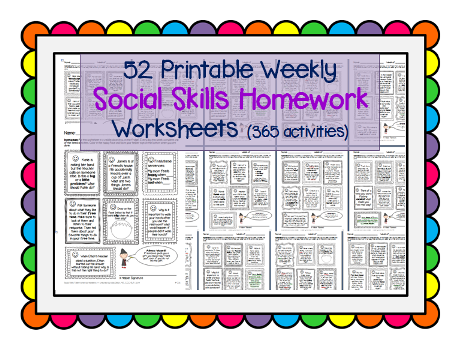
I don't want to brag, but I dare say that I may have completed my magnum opus: a packet of weekly social skills worksheets to last me throughout the year. This was a long-term project that I had been planning and working on for a while, since there was quite a need among my caseload. 

I created 365 social skills prompts /scenarios and distributed them across a 52-page document so that they can be sent home on a weekly basis. The activities are designed to target a variety of skills, including:
-Social problem solving
-Conversation skills / pragmatics (Topic maintenance, Turn-taking, Eye Contact, Proxemics, etc.)
-Critical thinking skills
-Cooperative play skills
-Figurative language
-Feelings / emotions
-Anger management
-Manners / Etiquette
-Social Inferencing
-Perspective taking
-Positive character traits
-Cause & effect / Predicting outcomes
-Flexible thinking
-Conflict resolution

This makes these worksheets the perfect Speech homework for students on the Autism Spectrum (HFA), those with Social skill or problem-solving deficits, those working on pragmatics, or even just our language kiddos. In addition to the activities, I included an “Advice Wizard” on each page, that offers a little tidbit of social advice. I also included a blank page so that specific scenarios can be added as needed. A sample page looks like this:
Sample social skills homework page
I did make this product available in my TpT store here. It is a little bit more expensive than the rest of my materials due to the extensive amount of time I put into it.
http://www.teacherspayteachers.com/Product/Social-Skills-Weekly-Homework-Worksheets-365-activities-Speech-ASD-Pragmatic-1120085

I really hope that my own students will benefit from this program -- it is so difficult to find relevant worksheets for social skills and I always have parents asking me what they can do at home to practice social skills. And I know my students will be so excited to get Speech homework!

Okay, I'm off to take some Motrin! This project really did a number on my head!
~Viola

February 10, 2014

Valentine Social Skills

The Valentine festivities continue with my home-made activities! Because I have so many students working on social and conversation skills, I made a Valentine-themed activity targeting those areas (I had previously created similar activities for Thanksgiving and Christmas, and they were well-received by my students).

The purpose of this game is to get as many matching chocolates into a candy box by answering questions about social skills scenarios. Below is an example of some of the prompts:
Sample prompts.
Once they answer a question, students have to find the matching candy and place it onto the picture of a heart-shaped box. I am thinking that it might be fun to get a real candy box and have them place the candy in there! Maybe I will snag one up for next year when the Valentine sales begin on 02/15 :).

My student is placing a matching candy into the box.
I think my students' favorite aspect of this game was to find the matching chocolates, since they looked all so similar. I suppose this was great practice for their visual skills, as well! This activity is available in my TpT store here. It comes complete with 36 prompts and 9 blank cards to add your own to the mix.

~Viola

February 6, 2014

TpT Freebie: Valentine's Day Sequencing Cards

My downloadable freebie this month are Valentine's Day sequencing cards that I created in Boardmaker. 
I made these with some of my special day class students in mind. These would work well to review the routine of Valentine's Day, to use in a social story, or simply to work on sequencing. They are available here
 ~Viola

February 4, 2014

Valentine Conversation Hearts

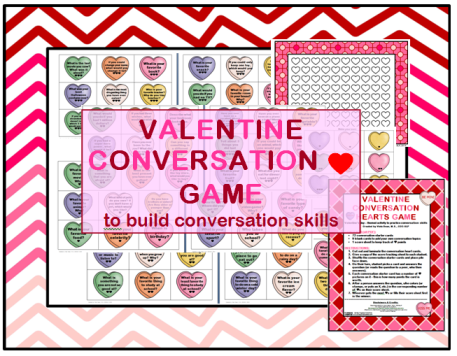
Last weekend I realized that Valentine's Day is almost upon us and I didn't really have any themed activities prepared for my students. They always really seem to get into the holidays, so I sat down and made a few materials for us to work on this and next week. A few months ago I had purchased some cute Valentine candy clip art which came in handy in creating a conversation hearts activity to practice pragmatics, expressive language, and articulation generalization skills. 

The objective of the game is simple: Answer a question and earn as many heart points as you can to win. When it is a student's turn, they draw a conversation hearts card. These cards contain conversation starters and personal questions. If they answer the question using good pragmatics, grammar, or articulation, they earn the points depicted on the bottom of the card.
An example of the conversation heart cards.
Once they earn the points, they mark the number on a score sheet. See-through plastic pouches or sheet protectors work wonderfully for this and save paper and ink.
The score sheet.
I told students that they could either color in the hearts or just mark them with an X, depending on their personal preference (a lesson I learned today is that some students are meticulous about coloring in the lines, which can make it take forever).
My 1st grade boy preferred making X's.
My 1st grade girl preferred coloring the hearts.
All in all, this activity was a lot of fun for my students. They couldn't wait to see who would have the most points by the end of our session! And the best part is, I can re-use this activity again and again. It is available for purchase in my TpT store here.
This game is available here.
I have some more cute VD activities planned, and I am hoping to trial them and post updates soon! Happy Valentine's Day!
~Viola

November 10, 2013

TpT Freebie: Idiomatic Expressions Checklist

With the rise of Autism Spectrum Disorders I have more and more students each year who struggle with figurative language. My TpT Freebie for November is a checklist containing a large variety of common idiomatic expressions that our students may come across in different settings. I made this to help me assess which idioms my students are already familiar with and which ones they still need to master. Of course this list is not comprehensive, but it is a start. You can make checks in different colors (e.g., green for mastered, red for expressions that are not mastered) to help you visually organize your targets.
Idiomatic Expressions Checklist - get it here
I have also sent this list home with parents and asked for their input as to which expressions they would like me to work on. I hope you find this helpful!
~Viola

November 7, 2013

Vocalic /r/ -- tURkey wORds

A lot of my /r/ students do well on their target sound until we hit vocalic /r/, so I decided to try and make a little fun activity for them. Using the theme of Thanksgiving and some clipart, I made a bunch of turkey visuals to work on that skill. Here is what one of them looks like:
Vocalic /r/ turkey.
Students are expected to blend a variety of onsets with particular vocalic /r/ word endings to create and record new words. What I like about this activity is that there is lots of repetition of the same type of vocalic /r/ and it works on phonological awareness skills, as well. (I quickly realized that this activity worked best with students who only had articulation deficits, those with language delays needed a lot more prompting and help.)

After generating and practicing a specific word, students then recorded the word on a worksheet. I told them that spelling didn't matter as long as they practiced it the right way. With some of my older students we talked about different spellings of the same word (e.g., pear vs. pair) and discussed the meaning of each. 

One of my hard-working 3rd graders.
When they were done with each word, students got to cross it out (using a re-usable dry erase pouch). Halfway through creating this activity I realized that Chipper Chat tokens fit perfectly onto the circles, too. This was not intended, just a really fortunate coincidence.
Crossing out words we found.
Happy coincidence!
I have made this activity available on TpT here. Hopefully my students will be able to say that they had "tURkey", not "tAWkey" for Thanksgiving dinner!
~Viola

October 25, 2013

Speech Jeopardy

One of my favorite whole-group activities to do with my Speech students is Jeopardy -- I have modified this game to target different goal areas / age groups. I have made Artic Jeopardies, Language Jeopardies, SDC Jeopardies, ... the options are endless. Technically speaking it is not really "Jeopardy", since I do not require my students to answer in question format. It is more of a quiz show type competition. Since my students really enjoy this activity (and if they enjoy something, they will work hard!), I thought I would devote a blog post to it.

I have made and accumulated several Jeopardy versions to target different goal areas (I think I have around 6 different /r/ game templates) and am starting to transfer them into an electronic format so that I can make them available to other SLPs through TpT. Making them is quite an involved process, however, the good news is, once they are made, you can re-use them over and over.

I most recently made a language Jeopardy for my 2nd-3rd grade Special Day Class that we played today. The difficulty level of the questions is appropriate for regular education Preschool / Kindergarten students, as well. The categories I incorporated are relatively simple, and match the goal areas my students have been working on in therapy (prepositions, categories, opposites, inferencing, and emotions). Once I was sure of the categories I wanted to use, I came up with five questions for each and typed them up, along with a header for each question type. At this stage I also decided on a point value for each question -- the easier questions are worth fewer points, whereas the harder questions are worth more points. I also made sure to incorporate "Double Jeopardy" questions (worth twice the points!). Then, I printed this whole mess!

At this stage, my project looked something like this:
The early stages! Note that you will also need scissors, 5x8" note cards, and glue.
The next stage entails gluing the questions onto one side of the note card, and the corresponding point value onto the other side (make sure the colors match!).
Side one.
Side two.
I also glue the headers onto some construction paper of a like color. It makes them look nice and at the same time more durable. The last step (although optional) is to laminate each item -- that way your game will last a long time.

Laminated/finished game.

Once you are ready to play the game, you will have to set it up by taping/pinning the categories and questions in a visible place (usually the whiteboard works).

Jeopardy cards taped onto the whiteboard.
Now for the fun part! I have come up with two variations to play this game:

Version 1 (my preferred for SDC groups or younger students)
1. This version allows students to play versus the teacher / SLP.
2. Students take turns choosing a category / point value (e.g., Opposites 300).
3. The question is read out loud.
4. Students then have to come up with the correct answer as a team. (Or you can take turns calling on them until someone gets it right, which is what I usually do).
5. If someone knows the answer, they get the points. If they do not know the answer, the teacher/SLP gets the points.
6.Whoever has the most points at the end is the winner!

Version 2 (my preferred for older students):
1.Divide students into teams.
2.On their turn, a team gets to decide on a category and point value. 
3. The question is read out loud. 
4. The team has to collaborate thinking of the correct answer -- no blurting out or they lose their turn!
5. If the team answers correctly, the team gets the points. If the answer is incorrect, the other team gets a shot. Teams take turns picking questions.
6.The team with the most points wins.

A rule for both variations: Questions with stars on them are "Double Jeopardy" cards and worth twice the points.
An example of a Double Jeopardy card.
For Articulation Jeopardy, all of the answers have the target sound in them. After they answer correctly, all of the students have to chorally practice the target word x number of times. Like I said, this activity is very adaptable.

If you choose to make your own Jeopardy game, the first step is to think up five categories that you want to use. Next, you have to come up with five questions for each category. Once you have your categories / questions thought up, you will have to transfer them onto index cards. On the back of each index card, you assign a point value (100-500 for each category). Make sure that easier questions have a lower value. I have a free Jeopardy Number template available in my TpT store here. You also need to make a header for each category that you have chosen. 

If you would prefer to save yourself the work and buy one of my templates, I currently have a Language Jeopardy (appropriate for 2nd-3rd graders working on Language goals) and the SDC/Preschool/Kindergarten Language Jeopardy game described above available on TpT.

The reason I love Jeopardy so much is that it allows you to see a lot of students at once. This is especially helpful when you are trying to make up missed sessions for several students. In addition, this activity is great for promoting cooperative / team skills in your classroom in addition to building speech and language skills. While the preparation takes some effort, once the cards are made you can laminate them for durability and reuse it every year! Win!
~Viola