Do you like to use games in Speech, but are tired of playing the same ones over and over? This Blog series will introduce some of my personal favorites!
Please note: This post contains affiliate links.
I love playing games with my students, both for motivation with my younger kids as well as for educational purposes. Games are so great for working on social skills such as turn-taking, conversation skills, sportsmanship, etc. The posts in this series will be organized based on the types of games, and will include cause & effect games, vocabulary games, cooperative games, logic/strategy games, movement games, card games, and social skills games.
The first games I want to talk about are Cause and Effect games - these are games where one action makes something else happen, and these games work really well with my SDC and younger students.
1. Pop Up Pirate: Most of you probably own this game, but if you don't - get it! Turns are fast and this game is highly motivating for students of all ages. Players take turns sticking swords into a barrel until the pirate pops out. Language skills you can target are color identification, requesting, as well as concepts "in" and "out of". Because each turn is super-fast, it lends itself well to a quick motivator.
 |
| Pop-up Pirate |
2. Pop the Pig: My SLPA introduced me to this game and this is another favorite of my students. Students take turns rolling a die and feeding the pig hamburgers. At the end of their turn, they press down on the pig's head, making his belly expand. If the pig's shirt pops open, the player wins. Good skills to target are color identification, counting, the concepts "down", and turn taking.
3. Crocodile Dentist: This is another favorite with quick turns. Players take turns pushing down a tooth until the crocodile's jaws snap shut. Good concepts to target are "push", "down", "closed", and "open". When you buy this, make sure you get the Hasbro version - the knock-offs don't work well, as indicated by other reviewers.
 |
Crocodile Dentist
|
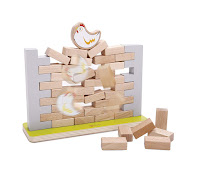
4. Pick a Brick: I have a love-hate relationship with the game Jenga. While I like the concept, any little bump against the therapy table makes the whole thing come crashing down. This is where Pick a Brick is a great substitution and perfect for little preschool hands, too! The concept is similar to Jenga - players remove a block by pushing it out of a wall. The goal is not to make the chicken that sits on top fall down. A difference is that blocks do not get stacked on top of the wall after being removed. Because the blocks are being contained between two pillars and sit on a sturdy base, the blocks don't fall down if the table gets bumped (although the chicken might fall off). Concepts to target include "push", "on top", "off".
 |
| Pick a Brick |
5. Funny Bunny: This game gets requested often by my students. Players move their bunnies up a mountain while trying not to fall into the holes on the path. I have a more in-depth review of Funny Bunny
here. Skills to target include counting and words for final consonant deletion.
 |
| Funny Bunny |
6. Bunny Hop: This game is another popular choice among my students. A more in depth post about it can be found
here. Students roll a die and see if a bunny of a particular color will jump out of the board when a farmer is pressed down. The first player to collect a bunny of each color is the winner. Good skills that are being targeted with this game are color identification and memory.
 |
| Bunny Hop |
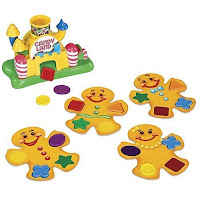
7. Candyland Castle: This is one of my favorites, but unfortunately it is out of print (I already e-mailed Hasbro about it - no chance of this one coming back anytime soon). If you ever see it in a thrift store or at a yard sale -- grab it! Every player has a gingerbread man board with four shapes on it. Players take turns pulling the candy cane on the castle to make a plastic shape pop out of the gate. If the shape matches one of the shapes on their board, they get to put it on. This game is perfect for preschool and younger students. Turns are quick and you can target shapes, colors, and turn-taking.
 |
| Candyland Castle |
8. Cariboo: No list would be complete without Cariboo... which is sadly out of print (time to hit up the thrift store!). You all know this one-- Players pull cards and use a key to open compartments that have a matching attribute. If they find a ball they place the ball in a hole to see if the treasure chest will open. It is the perfect game to target letter / shape / color / number identification, memory, and matching. Additionally, you can replace the cards with your own to target specific language skills. Cariboo is one of my most requested games and I feel so fortunate to own a copy!
 |
| Cariboo |
9. There's a Yeti in My Spaghetti: This is one of the newer additions to my speech room, and so far my kids have been enjoying it! Players pull out spaghetti in such a way to prevent the yeti from falling into the bowl. It's a good game for strategizing and turn-taking.
 |
There's a Yeti in My Spaghetti
|
10. Jumping Jack: This game is like a reverse pop-up pirate. Players spin the spinner and either pull out 1 or two carrots, lose a turn, or take a carrot out of their basket. If the bunny jumps out when a carrot is removed, the player has to be able to catch the bunny to win. Otherwise the player with the most carrots is the winner. While I prefer Pop-up Pirate (faster turns, longer game play), this game is nice to throw into the game rotation.
 |
| Jumping Jack |
What Cause-and-Effect games do you play in YOUR therapy room? Please share in the comments!


 ”, “
”, “ ”, and “
 ”, all of which involve having students ask questions to guess a mystery item.
  toy. You ask a Yes/No question
 work great for this). Students then have to guess the item by asking yes/no questions (e.g., Is it an animal? Is it red?) until they guess the item.
  .
.
 by Audrey Penn - This is a well-known classic. When Chester Raccoon is nervous about his first day of school, his mother teaches him a secret that will ensure he knows that she is with him always. Great for kids struggling with separation anxiety from their parents.
 by Julie Danneberg - This is one of my favorites! The main character does not want to get out of bed on the first day of school, and imagines how horrible it will be. In a twist at the end it is revealed that the main character is a teacher. Can anyone else relate?
 by Jane Yolen & Mark Teague - With funny rhymes and hilarious pictures the authors describe how dinosaurs might act if they went to school. This would be a great book for younger readers and lends itself to talking about appropriate behavior at school.
 by Judy Finchler - When the main character's teacher moves into his apartment complex, he is hit by the realization that she doesn't live in her classroom after all. Sometimes it sure feels like I live in my Speech room...
 by Dianne deGroat - This story follows Gilbert through his first day of first grade. I like this book because it features realistic situations, from worrying about first grade being difficult, to learning about all the classroom rules, to eating in the cafeteria, etc. It's a very sweet book with innocent pictures.
 by Kevin Henkes - Chrysanthemum loves her name. That is, until she starts school and the other children mock her for it. It is not until her teacher reveals an equally unusual name that the other children accept her. It's a cute story about fitting in and accepting others despite their differences.
 by Joseph Slate - This rhyming book follows Miss Bindergarten and her students as they get ready for class. A great book to talk about morning routines. This is a good choice for younger students.
 by Mike Boldt - Anya wakes up on the first day of school only to discover that she has grown a tiger tail. Fearing the jeers of the other children, she does everything to get out of having to go to school. When she finally does arrive to school she discovers that several other children have also sprouted animal body parts. Students really appreciate the funny story and hilarious pictures.
 by Sharon Creech - This book is pretty funny, too (as are the illustrations). Tillie attends Mr. Keene's school. Mr. Keene loves his school so much that he decrees that students and teachers will also have school on weekends, holidays, and break. Neither the students nor the teachers want to go to school every day, but because they don't want to hurt Mr. Keene's feelings no one wants to speak up. Finally, Tillie convinces Mr. Keene that she is needed at home to teach her little brother and dog new things. In the end Mr. Keene relents and gives teachers and students their free time back.
 by Stephen Krensky - This is a story about a student who believes all of his teachers live at school. He fantasizes about how his teachers act after the students leave. When he sees her at the park with her husband and daughter, he concludes that she must have a secret life. A good book to use for teachers to introduce themselves to students and share information about their own life.
 by Harry G. Allard - Another well-known favorite. Miss Nelson's class is full o misbehaving students. One day, Miss Nelson disappears and a new teacher shows up. Unlike sweet Miss Nelson, Miss Swamp is strict and direct. The students hypothesize what might have happened to Miss Nelson and fear that they will be stuck with Miss Swamp forever, until Miss Nelson returns. From now on, her students are perfect little angels. In the end it is revealed that Miss Swamp was Miss Nelson in disguise. A great book to talk appropriate classroom behaviors.
 by David Shannon - I have never met a kid who didn't love the David books. In this edition, David gets in trouble around the classroom. This book is a great way to talk about classroom and school rules.
 by Eric Litwin - Pete the Cat is rocking his School Shoes in this book. Readers get to guess which part of school Pete is in after each page as they follow him through his school day. This is a great choice for younger students.
 by David Shannon - Camilla Cream likes to fit in to the point of where she refuses to eat lima beans only because her friends don't like them. But on the first day of school she wakes up with rainbow stripes all over her body! When she goes to school, her condition is such a big distraction to her classmates that the principal orders her to stay home. Doctors are working to help cure Camilla, but every treatment seems to exacerbate the problem. In the end, the cure is a large helping of lima beans. This is a great story about individual differences and trying to fit in.
 by Kay Winters - A teacher asks her students to share their wishes for the school year. A quick, easy read for younger students. You can also launch into a discussion about what your students are hoping for this school year.
 by Natasha Wing - This rhyming book follows the main character as she completes her back to school preparations and goes through the first day of school. A little hiccup occurs when the main character ends up in a different class than her best friend and is forced to make new friends. This is a good story to talk about forming new friendships.