Products About Me Home Classroom Freebies TeachersPayTeachers Pinterest Email Facebook Image Map
Showing posts with label Critical Thinking. Show all posts

September 27, 2016

Game Review: uKloo Riddle Edition

I usually have a ton of students working on either inferencing or listening comprehension (or both), so I am always on the lookout for great materials to use with this population. Since it is always more motivating for students when an activity looks like an actual game, I was fortunate to stumble across uKloo Riddle Edition and be provided with the opportunity to review it.

uKloo essentially consists of 75 cards, each of which contains clues about a secret item. Players have to listen carefully and use their critical thinking and inferencing skills to figure out the mystery item. This is very similar to speech therapy activities where you give three clues and have students figure out what object is being described. However, uKloo takes it a step further by only providing only a simple sentence, thereby making this activity more challenging. The game box also contains a little paper pad for you to create your own riddles, which would be an excellent extension activity once students have mastered the clue cards.

Another great aspect of this game is that there are three difficulty levels (25 cards each). That way, you can tailor this activity to different students' needs. Here are some sample riddles:

Level 1: Always white, sometimes brown, builds your bones when it goes down.
Level 2: Isn't it a curious thing, to fight cavities with a string?
Level 3: Poke your fingers through my eyes, while I cut things down to size.

Were you able to figure out the mystery items? The respective answers were milk, dental floss, and scissors. I played this game with my 4th and 5th grade language students and most of them were challenged enough with level 1 or 2.

Obviously you don't need to be a speech therapist to enjoy this game at home -- this game can also serve as a treasure hunt where players find the mystery item in their home. The next clue card is then hidden with the item. 

For more information, you can also check out this video on YouTube:


uKloo Riddle Edition reminds me of that chapter in J.R.R. Tolkien's "The Hobbit", where Gollum challenges Bilbo with riddles. All in all, it's an awesome game that you can use to target multiple skills.

Also make sure to check out uKloo Early Reader Edition (which is also available as an App for your iPad).

January 25, 2015

Teaching Creative Problem Solving through Play

Note: This post contains affiliate links.

The family of one of my third graders gifted me an amazing game for Christmas: "Obstacles" by eeBoo. This award-winning educational game is designed to teach creativity and imaginative problem solving skills through cooperative play. Obstacles has  become a therapy staple over the previous month and all of my students ranging from grades 1 through 5 are thoroughly enjoying it!

Obstacles is designed for 2-5 players ages 5 and up. It consists of 25 large rectangular "obstacle" cards and 100 smaller square "tool" cards. The objective of the game is to utilize the tool cards in a creative way to overcome the obstacles in order to reach your home. The obstacle cards consist of a variety of barriers to prevent you from reaching the home card: there are bees, swamps, thunderstorms, walls, borders, mazes, ogres, poison ivy, etc., all of which have to be overcome. And all players have are their tools. The tool cards contain some very useful to some very bizarre items: a kite, a silver platter, a bow & arrows, a drum, ice, a saw, a rocket, a jack-in-the-box, salt & pepper, a monkey, a compass, etc.

To play, the dealer randomly places obstacle cards on the table to create a path. For a short game, fewer cards are used, for a long game, more cards are used. My students always want the longest path possible (i.e. the length of our therapy table).

According to my students, the longer the obstacle path, the better! I hope you have a long table...
Each player then receives a number of tool cards (this number changes based on the amount of people playing). To make it easier for students you can give them more tool cards, to make it more challenging, you can give them fewer. These tool cards are placed openly in front of each player.

The first player chooses a tool card and explains how they would overcome the first obstacle on the path. Players then take turns doing the same. The rules encourage players to use their imagination and be creative -- for example you could use the salt and pepper tool card to make yourself sneeze so hard that all the sand gets blown out of the desert. Once each player has made a proposal about how an obstacle should be overcome, the group discusses additional possible solutions (tool cards may even be combined). After the discussion, the group votes for the best solution and discards the tool cards that were used during this turn. Players replenish their hands and tackle the next obstacle.

I have modified the rules a little bit to suit my own needs better. I give each student their picture from my schedule board to be placed at the beginning of the path. This picture acts as a game pawn and allows students to track their progress. Each student then receives four tool cards (I found that this allowed for just the right challenge level). Students then take turns proposing how one of their tool cards can be used to overcome an obstacle. If the group agrees that this is a viable option, they discard their old tool card, advance to the next obstacle, and add a new tool card to their hand. If a student gets "stuck", I allow them to ask other players for ideas or discard one of their tool cards for a new one (in lieu of their turn).


Bees, a border, tacks, and poison ivy... above are the tools my students used to overcome each obstacle!
This game gives me a good idea of which students can think "outside the box" and use their creative thinking skills to overcome these obstacles. My HFA groups are struggling with this, so it is a good exercise to improve in this area.

This game also lends itself to teaching students great new vocabulary, as many of the tools consist of items they may not be familiar with: stilts, lever, compass, catapult, tacks, fabric, sewing, copper pot, pulley, are just some examples.

In terms of quality, the cards are made of a thick sturdy cardstock that will hold up to little hands. Obstacles is a fantastic game and I can't recommend it enough!

January 22, 2015

Teaching Students How to Size Up a Problem

https://www.teacherspayteachers.com/Product/Problem-Solving-Pack-Unit-on-little-medium-big-problems-social-skills-ASD-1279690
Get it here!
I haven't advertised a TPT item in a while, so I thought I would showcase one of the

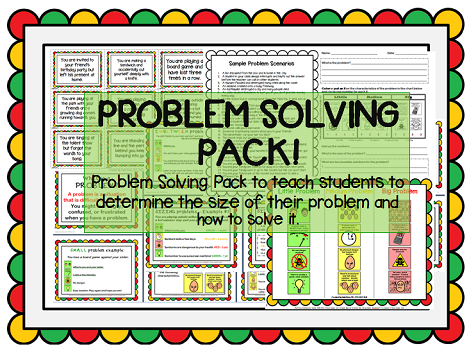
more popular items in my store: a "Problem Solving Pack" created to show students how to accurately define the size of a problem and to teach basic critical thinking and beginning problem-solving skills. 

I have a lot of kiddos on my caseload that have a complete meltdown when they lose a game or during some other trivial mishap, which is what inspired me to create this resource. Since this is usually an area of need for students on the ASD spectrum or those with social communication disorder, most SLPs can probably find value in this packet.

Problem sizes are grouped by little, medium, and big, and in order to fit a particular size, students are encouraged to think of the four aspects that make up a problem:

(1) the number of people involved in or affected by the problem
(2) the duration of the problem
(3) the level of physical danger involved
(4) the time it takes to solve this problem

I assigned numerical values to each characteristic, which helps students "calculate" the actual problem size in a very structured manner. Students can then fill out an accompanying worksheet to help them organize and guide their thought process.
Overall, this packet includes the following PDF files:
• A collection of 120 premade problem scenarios in two separate formats (as 3.6” X 2.6” cards as well as in black and white list format)
• 9 blank cards to add your own scenarios as they occur in your students’ lives

• A step by step lesson plan / presentation to go over with your students
• A letter-sized visual poster to remind students of the characteristics of each problem size (both color and black and white)
• A worksheet template to help guide students through analyzing a problem's size
• 4 sample worksheets to guide the teacher / therapist on how the questions should be answered

I created and improved upon this packet throughout the last school year as I was developing and using these lessons with my own students in a social skills group and small group therapy setting. It really seemed to work for many of them – I, as well as other support staff have noted some marked improvements in target students’ reasoning and behavior control skills about daily challenges.

I have used these materials with 1st through 5th graders (although the worksheet is geared towards my older groups), but will work well for middle school and high school students as well due to the relative complexity of the subject. You can also just use the problem solving cards as a quick therapy activity to work on identifying and solving problems. 


For some other great resources on problem-solving using the four problem characteristics, visit Jill Kuzma's blog. There are also some great resources on Pinterest. Problem-solving is such a basic skill that we take for granted. It is important to remember that many of our students need guided teaching to improve and master this concept.
~Viola