Do you like to use games in Speech, but are tired of playing the same ones over and over? This Blog series will introduce some of my personal favorites!
Please note: This post contains affiliate links.
I love playing games with my students, both for motivation with my younger kids as well as for educational purposes. Games are so great for working on social skills such as turn-taking, conversation skills, sportsmanship, etc. The posts in this series will be organized based on the types of games, and will include cause & effect games, vocabulary games, cooperative games, logic/strategy games, movement games, card games, and social skills games.
The first games I want to talk about are Cause and Effect games - these are games where one action makes something else happen, and these games work really well with my SDC and younger students.
1. Pop Up Pirate: Most of you probably own this game, but if you don't - get it! Turns are fast and this game is highly motivating for students of all ages. Players take turns sticking swords into a barrel until the pirate pops out. Language skills you can target are color identification, requesting, as well as concepts "in" and "out of". Because each turn is super-fast, it lends itself well to a quick motivator.
 |
| Pop-up Pirate |
2. Pop the Pig: My SLPA introduced me to this game and this is another favorite of my students. Students take turns rolling a die and feeding the pig hamburgers. At the end of their turn, they press down on the pig's head, making his belly expand. If the pig's shirt pops open, the player wins. Good skills to target are color identification, counting, the concepts "down", and turn taking.
3. Crocodile Dentist: This is another favorite with quick turns. Players take turns pushing down a tooth until the crocodile's jaws snap shut. Good concepts to target are "push", "down", "closed", and "open". When you buy this, make sure you get the Hasbro version - the knock-offs don't work well, as indicated by other reviewers.
 |
Crocodile Dentist
|
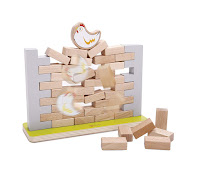
4. Pick a Brick: I have a love-hate relationship with the game Jenga. While I like the concept, any little bump against the therapy table makes the whole thing come crashing down. This is where Pick a Brick is a great substitution and perfect for little preschool hands, too! The concept is similar to Jenga - players remove a block by pushing it out of a wall. The goal is not to make the chicken that sits on top fall down. A difference is that blocks do not get stacked on top of the wall after being removed. Because the blocks are being contained between two pillars and sit on a sturdy base, the blocks don't fall down if the table gets bumped (although the chicken might fall off). Concepts to target include "push", "on top", "off".
 |
| Pick a Brick |
5. Funny Bunny: This game gets requested often by my students. Players move their bunnies up a mountain while trying not to fall into the holes on the path. I have a more in-depth review of Funny Bunny
here. Skills to target include counting and words for final consonant deletion.
 |
| Funny Bunny |
6. Bunny Hop: This game is another popular choice among my students. A more in depth post about it can be found
here. Students roll a die and see if a bunny of a particular color will jump out of the board when a farmer is pressed down. The first player to collect a bunny of each color is the winner. Good skills that are being targeted with this game are color identification and memory.
 |
| Bunny Hop |
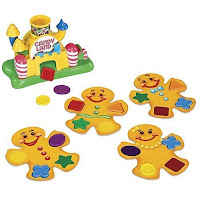
7. Candyland Castle: This is one of my favorites, but unfortunately it is out of print (I already e-mailed Hasbro about it - no chance of this one coming back anytime soon). If you ever see it in a thrift store or at a yard sale -- grab it! Every player has a gingerbread man board with four shapes on it. Players take turns pulling the candy cane on the castle to make a plastic shape pop out of the gate. If the shape matches one of the shapes on their board, they get to put it on. This game is perfect for preschool and younger students. Turns are quick and you can target shapes, colors, and turn-taking.
 |
| Candyland Castle |
8. Cariboo: No list would be complete without Cariboo... which is sadly out of print (time to hit up the thrift store!). You all know this one-- Players pull cards and use a key to open compartments that have a matching attribute. If they find a ball they place the ball in a hole to see if the treasure chest will open. It is the perfect game to target letter / shape / color / number identification, memory, and matching. Additionally, you can replace the cards with your own to target specific language skills. Cariboo is one of my most requested games and I feel so fortunate to own a copy!
 |
| Cariboo |
9. There's a Yeti in My Spaghetti: This is one of the newer additions to my speech room, and so far my kids have been enjoying it! Players pull out spaghetti in such a way to prevent the yeti from falling into the bowl. It's a good game for strategizing and turn-taking.
 |
There's a Yeti in My Spaghetti
|
10. Jumping Jack: This game is like a reverse pop-up pirate. Players spin the spinner and either pull out 1 or two carrots, lose a turn, or take a carrot out of their basket. If the bunny jumps out when a carrot is removed, the player has to be able to catch the bunny to win. Otherwise the player with the most carrots is the winner. While I prefer Pop-up Pirate (faster turns, longer game play), this game is nice to throw into the game rotation.
 |
| Jumping Jack |
What Cause-and-Effect games do you play in YOUR therapy room? Please share in the comments!


 by SmartGames. It had been on my Therapy wishlist forever, but I hesitated to buy it because of the steep price (close to $30). Now that I own the game I am so glad I do!
 (ages 6+): This cooperative game is one of the lesser known Peaceable Kingdom games, but just as awesome as the rest of the
 (ages 5+): Clumsy Witch is a great game for younger students, as you can change the complexity of the rules. Players help a witch find the missing ingredients for her potion. You have to plan your move in advance, so this game promotes strategy and planning skills.
 (ages 3+): This game is perfect for preschool and lower elementary! Players cooperate to feed the Woozle monster 12 snacks without dropping them onto the ground. The game board is 3-dimensional and players use a spoon to feed snack cards into the monster's mouth. What is especially great about this game is that there are three levels of play, which means that you can tailor the game to the level of your group. In more difficult settings, gross motor components are added, as well as the condition of having to feed the Woozle with eyes closed. As with all Peaceable Kingdom games, the components are of high quality. This is also a great game for year-round therapy.
 (ages 8+): This card game is won by having the lowest score at the end of four rounds. There are four different types of cards: black cats, walking under a ladder, broken mirrors, and Friday the 13th. Each card has a certain value. On their turn, players play a cat, ladder, or mirror card. The next player then plays a card from the same suit (or a "wild" Friday the 13th card) while being careful that the total value of the stack does not exceed 13. If the value is greater than 13, the player has to take the entire stack. Each card is worth one point, except for the Friday the 13th card, which is worth two. If a player has the most cards from a certain suit at the end, the suit is worth zero points. The game is easy to learn and rounds are quick. Because math / counting skills are involved, this game would likely work best with upper elementary / middle school students.
 (ages 8+): One of my favorite parts about this card game are the hilarious illustrations. Each player "owns" a haunted mansion and needs to drive away the ghosts. In addition to four cards featuring Halloween creatures, each player receives a face-down deck of cards, which is their mansion. The game consists of two phases, each of which consists of different actions players can take in order to get rid of the cards in their hand. There are also some special rules for certain cards. While the game is somewhat complex to learn initially, once you get the hang of it, it can be a quick game to play during speech sessions. I think upper elementary and middle school students are the best audience for this game.
 (ages 8+):
  (ages 3+): This game is great for young students. Players have to reach into a bag to match toy shapes on their game board. If they accidentally pull a monster shape out of the bag, players simply tell him to “go away”. Wonderful for teaching shape recognition!
 (ages 8+): This is one of my all-time favorite games EVER. I got it for Christmas when I was 8 and it just doesn’t get old. Players have to push cards to create pathways through a spooky maze and collect treasures. It is a great game to work on problem-solving, strategizing, and predicting. Turns can take long, so this may be a good game to play as a “reward” during weeks before a break.
 (ages 5+): In this game, players use a wooden spoon to retrieve sugar balls of a specific color in order to help the monster decorate his cake. Whoever has the right color combination of sugar balls first, gets a point. In this game, speed and dexterity count.
 (ages 3+): This is essentially a Bingo game with cute little monster shapes.
 (ages 8+): In this card game players have to feed monsters their favorite foods. However, the monsters are picky eaters, and if the wrong foods are given, players lose points.
 (ages 3+): This is such a cute game for younger (preschool) students. In this puzzle-type game, players collect cards in order to complete a monster before the puzzle of the “monster catcher” is completed.
 (ages 4+): I love love love this game!! Players cooperate to scare monsters back into the closet (i.e. the game box). On their turn, players flip over a monster card, which also depicts a specific toy (e.g., a soccer ball). Each monster is scared of this toy, so players have to flip toy tiles to find the matching item and scare the monster away. If players are unsuccessful after three attempts of flipp, another monster card is flipped. There are also different variations of this game to change up the difficulty level. The best part about it? Because the box serves as the game board, my students are cleaning up the game as they play! This game is perfect for elementary students, and even preschoolers. We'll be playing this for years to come!
 (ages 5+): This game is a little bit like Hisss, in that players have to draw monster tiles and add it onto others in order to build a monster. However, players have to be mindful and not make it so big that it can’t be finished.
 (ages 4+): In this card game, players compete to be the first one to create a monster using 6 different cards. Easy to learn and quick to play.
 (ages 3+): This is a great game for the preschool population! It’s basically memory featuring monsters making silly faces.
 (ages 8+): In this card game, players compete to be the first to score 150 points. Because it involves tracking points / basic math skills, this game may be best for older elementary and middle school students.
 (ages 5+): In this 3-D board game, players push monsters onto a stage without accidentally pushing off monsters that are already present. If you push another monster off, the other players receive points. This game requires a great deal of dexterity and patience.
  (ages 6+): The 3-D game board consists of two layers, the upper of which contains magnetic spiders. The objective of this game is for players to move their magnetic ant pawns on the lower level of the board to the game board corners, where food is found. Opponents can move the spiders in such a way to “catch” the other player’s ants, at which point the ants need to start over. This looks like a super cute and original game! I don’t actually own it yet, but it is one that is on my wish list. The downside is that because it is an import from Germany, the price is a tad out of hand for the US consumer.
 (ages 8+): In this risk-taking game, players climb have to roll a particular sum on dice in order to travel through the levels a haunted house and collect “Spookies” tokens. The player with the most tokens wins. Since a roll of the dice determines whether you win or lose tokens, a big component of this game is based on luck.
 (ages 4+): This is a board game with a memory component – the objective of the game is to move your pawn to the top of the stairs on the game board, but if a “Ghost” is rolled, a player may place a ghost piece over another player’s pawn. Players have to remember for the remainder of the game which pawn/ghost is theirs. This game is great for multiple age levels and works well with younger students, as well.
 (ages 7+): This is basically the Halloween Edition of the popular game “Spot It”. Players flip two cards containing multiple pictures and try to find the one picture pair that matches.
 (ages 6+): This game is one of my favorites! The concept is super original, too, which makes it worth the relatively high price (I got mine for $25 at Target). Basically, the game board consists of two layers, the lower of which contains walls. Players use their pawns to guide a magnet underneath the board in attempts to reach board spaces with specific treasures. If they hit a wall, the magnet drops and players have to move their pawns back to the starting position. The winning strategy is to remember where exactly the walls are. Definitely a must-have for year-round therapy!
 (ages 6+): This is another game that utilizes magnets. The game board consists of two layers, the upper of which is littered with holes. Garlic chips are placed on the top layer and players use an opposing magnet to guide a magnetic pawn in such a way to push the garlic chips off the board while avoiding the holes. This game is fairly tricky, and requires a great deal of patience and dexterity. Pro: This game glows in the dark! Con: It takes a couple of minutes to set up and might frustrate impulsive players.
 (ages 7+): In this cooperative game, players work together to find a stolen ring and protect the castle from an evil wizard. Using clues from an electronic talking chest, players decide which rooms of the castle to search before time runs out. Note: You will need batteries. Another down-side is that you may not be able to finish the game in a 30-minute session.
 (ages 8+): This is the all-familiar Yahtzee dice game with a spooky twist. This edition contains a Jack Skellington dice cup and the dice actually contain pictures of characters from the movie.
 (ages 7+): This card game consists of 75 cards, each of which pictures a zombie numbered 1-15. The goal is to get the lowest number of zombies in your hand. This game might work best with older students since it requires some counting and math skills.
 by Peaceable Kingdom. Quick and easy to learn, it is appropriate for ages 5 and up and takes about 15 minutes to play. In addition, turns are quick, which makes it perfect for Speech sessions.