Products About Me Home Classroom Freebies TeachersPayTeachers Pinterest Email Facebook Image Map

March 5, 2014

ThinkFun Review #3: Zingo! Time-Telling

Get Zingo! Time-Telling here.
The last of the games that I received from ThinkFun for review is Zingo! Time-Telling. This game is a fun way to teach kids how to interpret clocks and time. I think being able to tell time is very empowering to a lot of special needs students, since it will allow them to better be aware of how much time will have to pass until the next transition or their next break. Knowing how to read a clock will also help kids who have poor time management skills to better plan ahead and know how much time is left to complete a job. This is definitely a very functional skill that is vital to daily life.


Two difficulty levels.
Since I work with a lot of students who do not yet have this skill, we took a few sessions to expose them to the concept and practice using Zingo! Time-Telling. This game is similar to other versions of Zingo! in that it contains game boards, a Zing-zinger, and tiles. As with other versions, this game comes in two difficulty levels: one side of the board contains both analog clocks as well as the digital numbers underneath, whereas on the flipside only the analog clocks are shown. I used this game with groups of second and third-graders. Common Core State Standards require instruction for this concept beginning in first grade and culminating in third grade (1.MD.B.3, 2.MD.C.7, 3.MD.A.1), so I figured those were good groups to practice with.

My 2nd grader is matching up the tiles.
Prior to introducing this game, I did a quick pre-teaching lesson with a real clock just to warm students up to the idea. With my 2nd graders I used the easier difficulty and with my third-graders the more challenging one. This worked out perfectly, as it was right around the difficulty level they could handle. What I really liked about this game is that the hands are color coded to match up to the colors of the tiles. This makes it very visual for students and helps them determine which number corresponds to the hour and which number corresponds to the minute. We talked about the different clock icons and compared the clock's hands to the digital numbers. My older students had fun, too! We tried to figure out the tiles we needed to fill in our board before moving the Zing-zinger. I noted some marked improvement towards the end of the session: students needed fewer prompts, especially for the minute part. After they had filled up one board, they asked to play again. I love it when students are learning while playing!
My 3rd grader is trying to find a match.

This game might also be a great tool for older students to work on time application skills or sequential skills. You could use it to teach the concepts "before/after" or teach scheduling and time-management. Or, if you are a parent or teacher, you can simply use this game to drill those math common core standards. 

Once again, we have a ThinkFun winner! Please make sure to also check out my reviews of Rush Hour Jr. and Zingo! Word-Builder. I will be definitely on the lookout for more great games by this company.

~Viola


February 28, 2014

ThinkFun Review #2: Zingo! Word-Builder

http://www.amazon.com/gp/product/B00GRV5JMU/ref=s9_simh_gw_p21_d0_i1?pf_rd_m=ATVPDKIKX0DER&pf_rd_s=center-2&pf_rd_r=0JA6VVWJTZNYHZ2SQWY0&pf_rd_t=101&pf_rd_p=1688200382&pf_rd_i=507846
Available here!
A new addition to my Speech room this month is Zingo! Word-Builder, courtesy of ThinkFun. Many of you are probably aware of the regular version of Zingo!, a fun and novel way to play Bingo. Zingo! Word-Builder is similar to the original in that the game consists of game boards, plastic tiles, and a "Zing Zinger" (tile machine).

The game boards feature 3-letter words, with one or two of the letters missing. On their turn, students move the Zing Zinger to release two tiles and have to figure out if the letters can be used to create words on their game board. The person to complete their board first is the winner. There are two difficulty levels: one side of the board is missing only one letter (in either initial, medial, or final position), and the other side is missing 1-2 of the letters. One thing that is great about the game boards and plastic tiles is that all vowels are highlighted in red. This makes it very visual for students. Another positive aspect about this game is that the Zing Zinger now has slots on the top so that you can discard your tiles more easily (unlike my other/older version).
Level 1 - one letter is missing.

I played this game with my Speech students (Kindergarten through 2nd grade) and we had a lot of fun! This activity was great for practicing basic decoding skills and trying to figure out whether the created word was a real word or a non-sense word (only real words are allowed). Here are some additional ways you could adapt this game for Speech -- many of them targeting phonological awareness skills:
  • have students identify the beginning/middle/ending sounds
  • have students try to come up with rhyming words
  • prior to letting students move the Zing Zinger, ask them about the possible words they could make and which letters they would need
  • when students create a word, have them make a sentence using the word
  • after students make a word, ask them what other words they could have made if they had had the letter ___ instead
  • have students substitute sounds, e.g., "You made the word 'bat'. What word do we get if we say /h/ instead of /b/?"
    Level 2 - 1-2 letters missing.

In addition to playing this game in the Speech room, I wanted to see if this game could be easily adapted to a larger classroom environment (since this activity would be great for a lower elementary level language arts classroom). I asked one of our Kindergarten teachers if I could push-in for a guest lecture for 20 minutes of their day, and she kindly allowed me to come in. Many faces lit up when the kids saw the Zingo! box and I was greeted with a lot of, "I have that game at home!" (They were talking about the original version.) 


Zingo! using a document camera
I set up a game board and the Zing Zinger on the document camera so that the whole class could see it. Next, I had students take turns coming up, move the Zing Zinger, and try to figure out where to place the letter tiles on the board. When they got stuck, their peers were allowed to help. The kids *loved* moving the Zing Zinger. They were super motivated, and we know that motivation is positively linked to learning ;). I think this game would be a fantastic addition to any K-2nd grade classroom to use either in a whole group or during stations. I will also be sharing this game with our Special Day Class teacher, since many of her students are decoding at the basic CVC word level. 

There are several different Zingo! versions available - Sight Words, Counting, Bilingual... make sure to go check them out here. Also make sure to read my other ThinkFun review of Rush Hour Jr., a great Speech room addition! In a few days, I will be writing about another great game by this company, so stay tuned for more!
~Viola

February 21, 2014

ThinkFun Review #1: Rush Hour Jr.

This week I received a very generous game donation from ThinkFun, and wanted to spread the word about how wonderful this company's games are for use in Speech therapy (or any other educational or private setting). I already owned several of the company's games, all of which are a hit with my students, so adding even more TF products to my therapy inventory was a windfall! What I love about ThinkFun games is that they are designed to build students' reasoning and critical thinking skills -- which many of our students lack -- through play.

ThinkFun's website features a nice little grid that designates the various skills that are addressed by their products. It may help you decide which of their games work best for your setting. Find it here.

Over the next couple of weeks, I will be reviewing three exciting new games that I am currently trialing with my Speech population: Rush Hour Jr., Zingo! Time-Telling, and Zingo! Word Builder. I will be breaking up my reviews into individual blog entries in order to prevent information overload, so keep checking back often! Here we go :)

REVIEW #1: Rush Hour Jr.
Rush Hour Jr. - Get the 2014 edition here!
I have to be honest, I was a little bit skeptical at first as to how to use this game in speech therapy to effectively build language skills, because it is advertised as a single player game and seemingly does not involve language. Given that frame of mind, I probably would have never bought it! However, after playing it with several of my groups this week, it actually turns out that this is one of the best games I now have in my Speech room -- I wish I had gotten a hold of it sooner!!

The premise of this logic game is as follows: A square grid is placed on the table and a variety of vehicles (including an ice cream truck) are placed upon the grid as depicted on a playing card. The goal of the game is to shift the vehicles in such a way that a path is cleared for the ice cream truck to move to the exit.

Here is an example of one of the set-ups ("Easy" difficulty level):
Make a path for the ice cream truck
The vehicles on the grid can only move in four different directions: left, right, up, and down. And here it dawned on me: most of my students have no clue which way is left and which way is right! These are important concepts that our students are confronted with on a daily basis. This is where I realized the value of this game... and knowing that my students are heavily dependent on visuals, I created the following cards:
I used Boardmaker, but you can just hand-draw these.
I played this game with 1st grade regular ed. language students, 3rd grade regular ed. language students, and 3rd grade Special Day Class students with mild cognitive delays. When my students arrived, we talked about what the term "rush hour" means and introduced the directional vocabulary. I presented the game grid and let my students know that the ice cream truck needed our help getting out of traffic. By this point, my students were really intrigued by the colorful little cars that were set up on the grid and the fact that they had this utmost important job of helping the ice cream truck out.

I was working with groups of three students, so I had them sit next to each other on one side of the table, with me across from them. The person seated in the middle was the "Driver". The students sitting on each side were the "Navigators" who had to tell the driver where to go. The navigators took turns giving the driver instructions and the driver had to follow through. Since a lot of my students struggle with basic sentence formulation, I also gave them the following sentence frame:
"Move the (color) vehicle ____"
A sample instruction might be: "Move the blue vehicle left." My students had an epic amount fun with this! They got so excited when it was their turn to be the driver.
This was the set-up from my view.
As we were playing this game, I recognized that a huge variety of skills can be addressed through this game, making it a true gem for any speech room. Here are just a few of the skills that are targeted by playing Rush Hour Jr.:

* Directional Vocabulary Concepts: Soon after starting the game I realized that most of my students didn't even have a solid grasp on "up" versus "down". Who would have thought? By the end of our session, I did notice some marked improvement for all four of these concepts with some of my students - they needed less processing time to tell the driver which way to go.
* Listening / Following Directions: The driver had to attend to the navigator's instructions and ask for clarification when they weren't sure what the instructions were.
* Providing Instructions: This is not a skill that I often work on (although I should), so this was great practice for my students! It is a very functional skill that we all use on a daily basis.
* Category / Color Concepts: This activity solidified the concept of what qualifies as a "vehicle". It may also be nice practice for color concepts with our younger population.
* Logical thinking / Planning ahead: Students had to determine which of the vehicles could be moved on a given turn and figure out which one would be the best option by planning two steps ahead. This was challenging for most of my students, but I know that with practice and scaffolding, they can improve in this area.
* Impulsivity control: Sometimes the navigator tried to move the vehicle for the driver and needed a reminder that he was just giving instructions, not driving.
* Blurting out: At times, the second navigator tried to butt in when it was the first navigators turn. Great opportunity to work on interrupting!
* Social skills: This was a truly cooperative activity! Not only did students have to take turns, but they also had to respond appropriately when the navigator gave them a wrong direction (and the driver knew that they were wrong).

This game is also great for working on Vocalic /r/! All it takes is some different vocabulary! Instead of vehicle, you could have the students say "car" and instead of "up/down/left/right" use "upward/downward/backward/forward".
Vocalic /r/ visuals
This game was a true success. When it was time to leave, my students were reluctant to go because they wanted to keep playing. They were also begging me to do the "super-hard" set-ups (we only did easy ones) because they thought they could handle it :).

If you only have money for one of the games I will be reviewing, I recommend that you get Rush Hour Jr.! I actually purchased the regular version of this game for myself around the holidays because it was on sale on Amazon (and because I love ThinkFun games!), but haven't had a chance to play it yet. I guess I know what I will be doing this weekend!
~Viola

February 17, 2014

Social Skills Take-home Worksheets

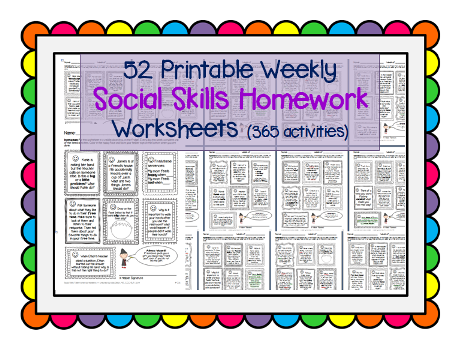
I don't want to brag, but I dare say that I may have completed my magnum opus: a packet of weekly social skills worksheets to last me throughout the year. This was a long-term project that I had been planning and working on for a while, since there was quite a need among my caseload. 

I created 365 social skills prompts /scenarios and distributed them across a 52-page document so that they can be sent home on a weekly basis. The activities are designed to target a variety of skills, including:
-Social problem solving
-Conversation skills / pragmatics (Topic maintenance, Turn-taking, Eye Contact, Proxemics, etc.)
-Critical thinking skills
-Cooperative play skills
-Figurative language
-Feelings / emotions
-Anger management
-Manners / Etiquette
-Social Inferencing
-Perspective taking
-Positive character traits
-Cause & effect / Predicting outcomes
-Flexible thinking
-Conflict resolution

This makes these worksheets the perfect Speech homework for students on the Autism Spectrum (HFA), those with Social skill or problem-solving deficits, those working on pragmatics, or even just our language kiddos. In addition to the activities, I included an “Advice Wizard” on each page, that offers a little tidbit of social advice. I also included a blank page so that specific scenarios can be added as needed. A sample page looks like this:
Sample social skills homework page
I did make this product available in my TpT store here. It is a little bit more expensive than the rest of my materials due to the extensive amount of time I put into it.
http://www.teacherspayteachers.com/Product/Social-Skills-Weekly-Homework-Worksheets-365-activities-Speech-ASD-Pragmatic-1120085

I really hope that my own students will benefit from this program -- it is so difficult to find relevant worksheets for social skills and I always have parents asking me what they can do at home to practice social skills. And I know my students will be so excited to get Speech homework!

Okay, I'm off to take some Motrin! This project really did a number on my head!
~Viola

February 15, 2014

Using Carrier Sentences and EET

Most of us are familiar with the Expanding Expressive Tool (EET) Program, designed to build students' describing skills by assigning colored circles to a specific property of an item. I use this program a lot with my students, and this week came up with a different way of using it with my cognitively lower functioning Special Day Class kids. A lot of my SDC students have difficulty constructing more complex grammatically correct sentences and have grammar/syntax goals along with conceptual (e.g., category, function) goals. Most of them know basic sight words and respond very well to carrier phrases, so I thought of using EET within the context of a modeled sentence. In our teacher workroom I found these long paper strips (about 1.5') with handwriting lines on them. After snagging a few, I created the following visuals:

EET carrier sentences.
I also own a box of noun picture cards from Language Builder that I like to use when working with EET, so I picked a few suitable cards for our session. I presented each stimulus item as follows:

"Group" & "Do"
Students were expected to fill in the "group" (green circle) and the "do" (blue circle) independently. For this example, an acceptable response would have been, "A fish is an animal that swims." This was a great way to work on 3rd person singular "-s" morphological markers, too! We also practiced this activity with other aspects of EET.
"An apple is a fruit that is red."
While my students often needed a couple of initial examples for each sentence strip, they caught on quickly!
"A sea gull is an animal that has feathers."
"A table is a furniture made of wood."
"A swimsuit is a clothing that you see at the beach."
We even combined multiple aspects of EET to build even more complex sentences:
"A tiger is an animal that roars in the jungle"
This level of support was exactly what my students needed to successfully build grammatically correct sentences and work on their conceptual language skills, as well. I'll be hanging on to these sentence strips and probably make a few more! The best part: This activity was practically free!
~Viola

February 10, 2014

Valentine Social Skills

The Valentine festivities continue with my home-made activities! Because I have so many students working on social and conversation skills, I made a Valentine-themed activity targeting those areas (I had previously created similar activities for Thanksgiving and Christmas, and they were well-received by my students).

The purpose of this game is to get as many matching chocolates into a candy box by answering questions about social skills scenarios. Below is an example of some of the prompts:
Sample prompts.
Once they answer a question, students have to find the matching candy and place it onto the picture of a heart-shaped box. I am thinking that it might be fun to get a real candy box and have them place the candy in there! Maybe I will snag one up for next year when the Valentine sales begin on 02/15 :).

My student is placing a matching candy into the box.
I think my students' favorite aspect of this game was to find the matching chocolates, since they looked all so similar. I suppose this was great practice for their visual skills, as well! This activity is available in my TpT store here. It comes complete with 36 prompts and 9 blank cards to add your own to the mix.

~Viola

February 6, 2014

TpT Freebie: Valentine's Day Sequencing Cards

My downloadable freebie this month are Valentine's Day sequencing cards that I created in Boardmaker. 
I made these with some of my special day class students in mind. These would work well to review the routine of Valentine's Day, to use in a social story, or simply to work on sequencing. They are available here
 ~Viola